United Kingdom 1982
"Death Centenary of Charles Darwin"
| Issue Date | 10.02.1982 |
| ID | Michel: 906-909; Scott: 965-968; Stanley Gibbons:1175-1178 Yvert: 102-1026 UPU: N/A Category: Dw |
| Design | Stamps - David Gentleman; The first day cover was designed by Sutherland Hawes & Associates. |
| Stamps in set | 4 |
| Value |
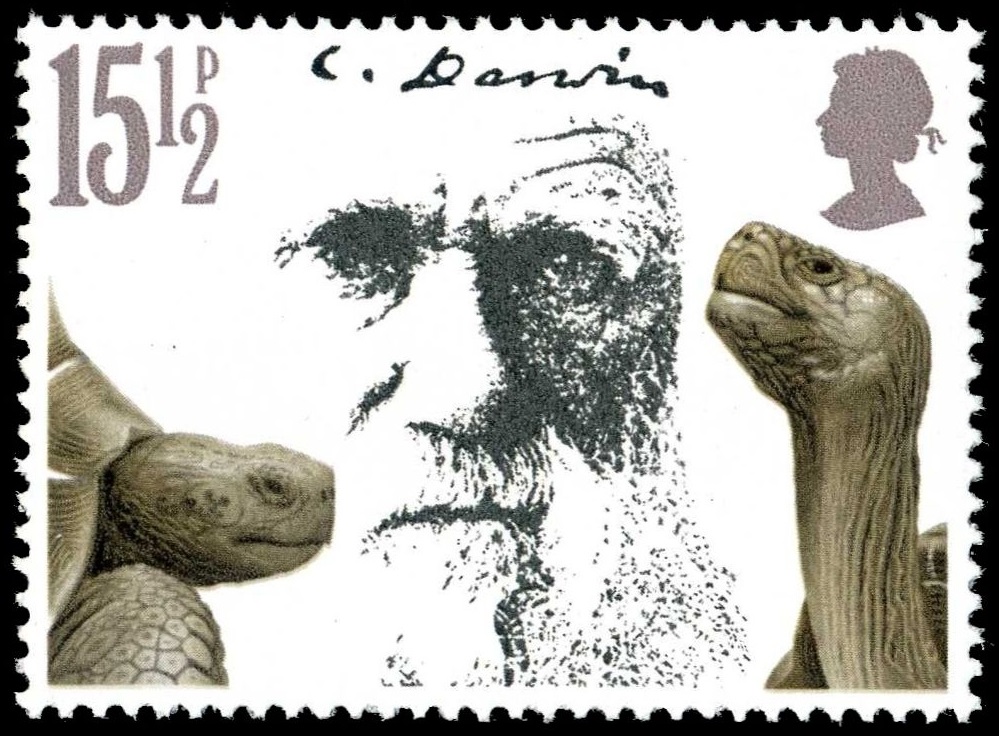
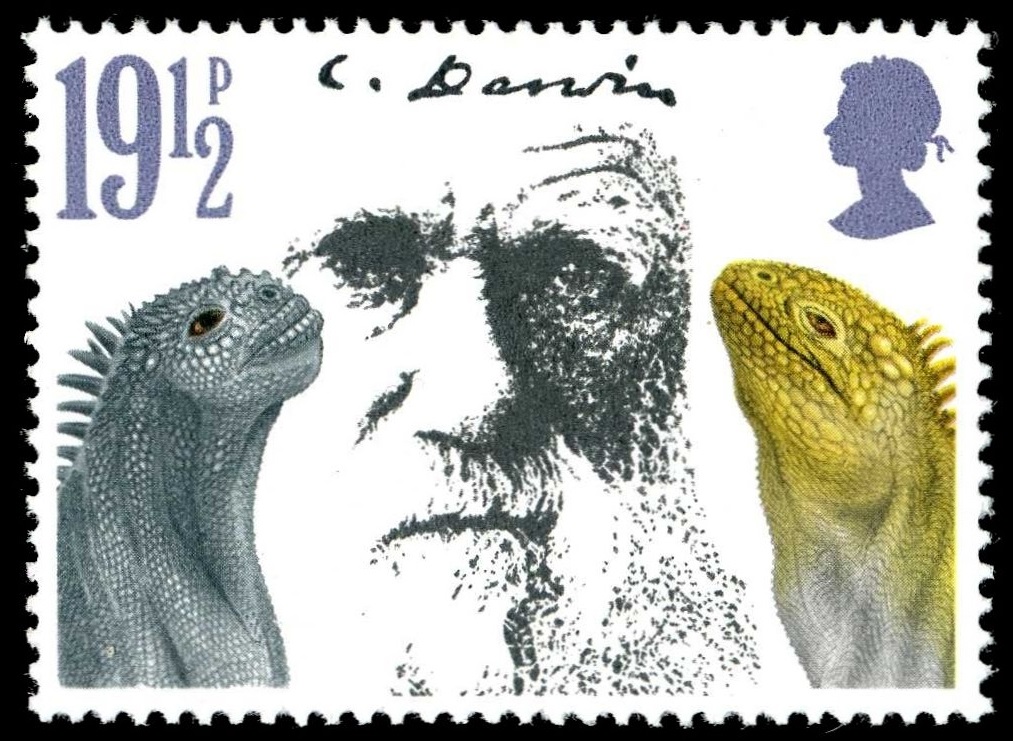
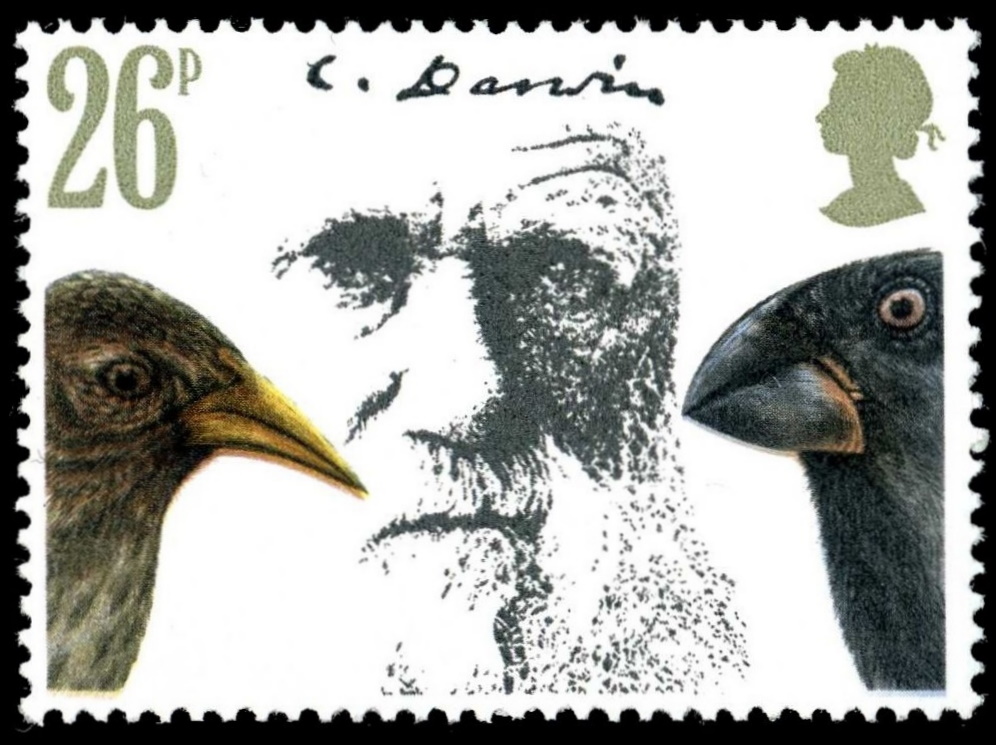
15p Charles Darwin and Giant Tortoises 19p Charles Darwin and Marine Iguanas 26p Charles Darwin and Cactus Ground Finch and Large Ground Finch 29p Charles Darwin and Prehistoric Skulls |
| Size (width x height) | 41x30 mm |
| Layout | 100 stamps per sheet |
| Products | FDC x 1 PP x1 |
| Paper | unwatermarked phosphor coated paper |
| Perforation | 15x14 |
| Print Technique | Photogravure |
| Printed by | Harrison & Sons (High Wycombe) Limited |
| Quantity | |
| Issuing Authority | Royal Mail of Great Britain |
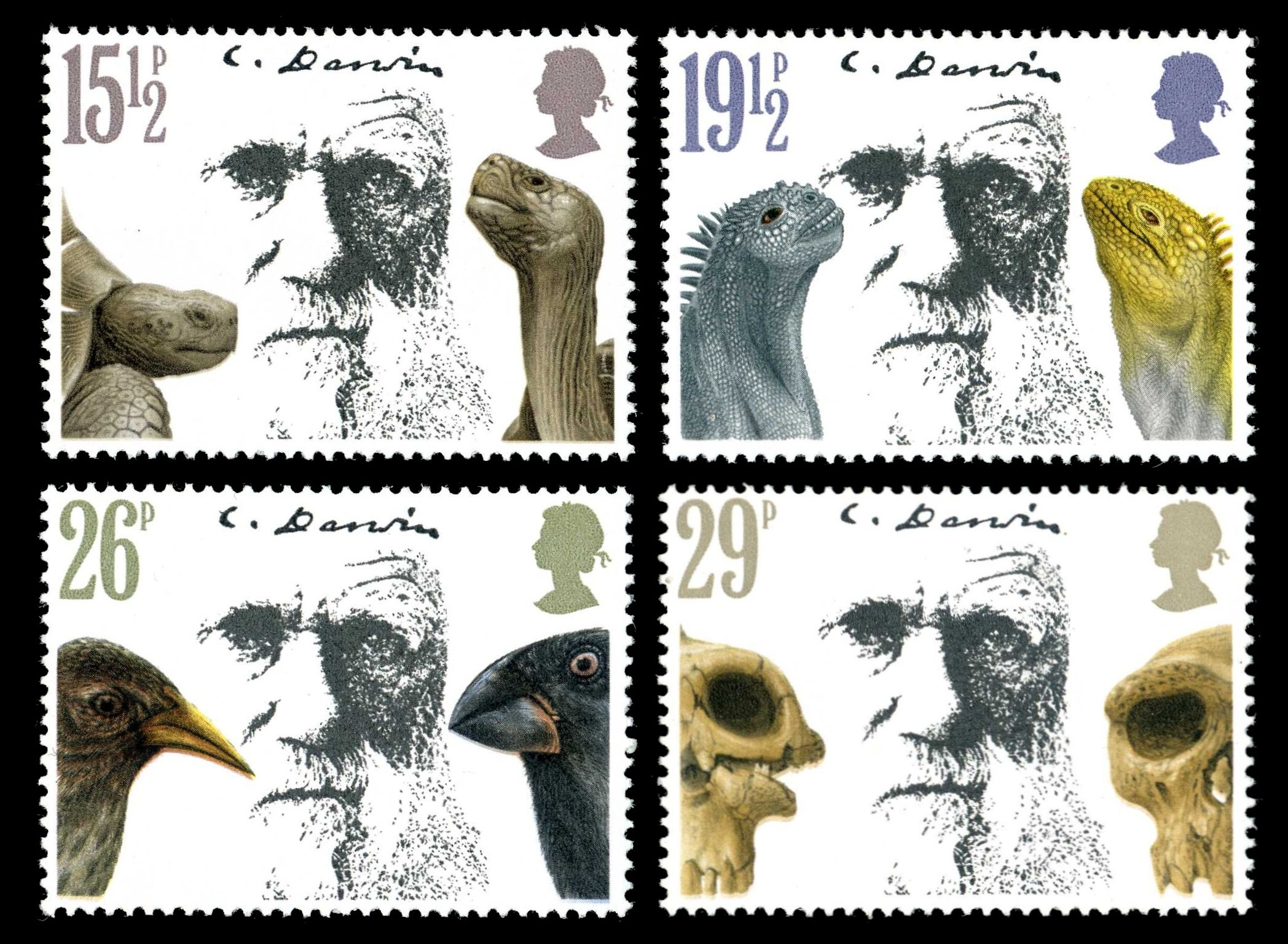
On February 10th, 1982, just days before the anniversary of the birth of Charles Darwin, Royal Mail issued a set of four stamps to commemorate the centenary of his death.
Each stamp shows a portrait of the late Darwin. Three of these stamps depict pairs of animals observed by the young Darwin during his visit to the Galápagos Islands, while the fourth stamp shows the skulls of two prehistoric human species — Australopithecus robustus and Homo erectus.
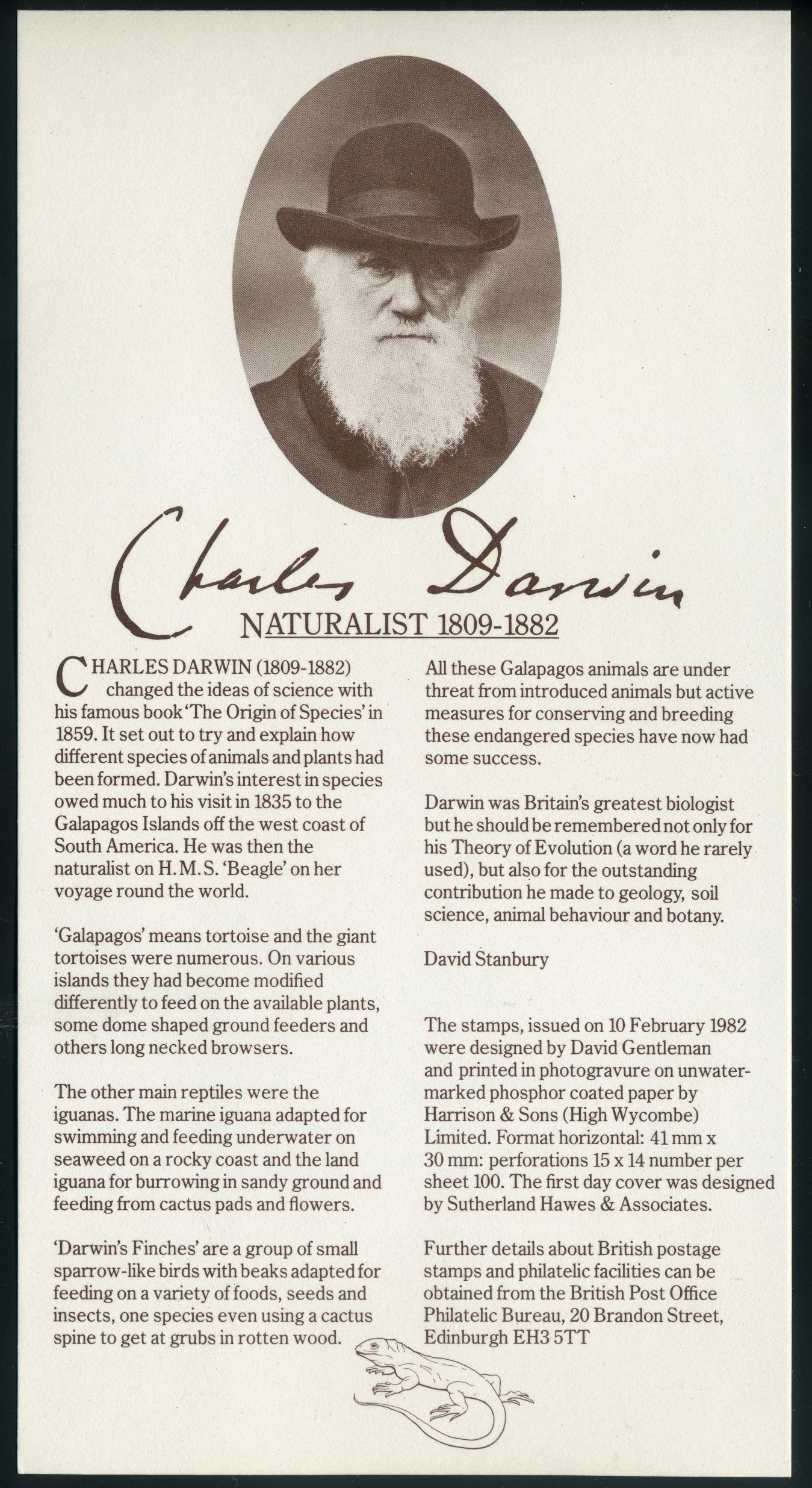
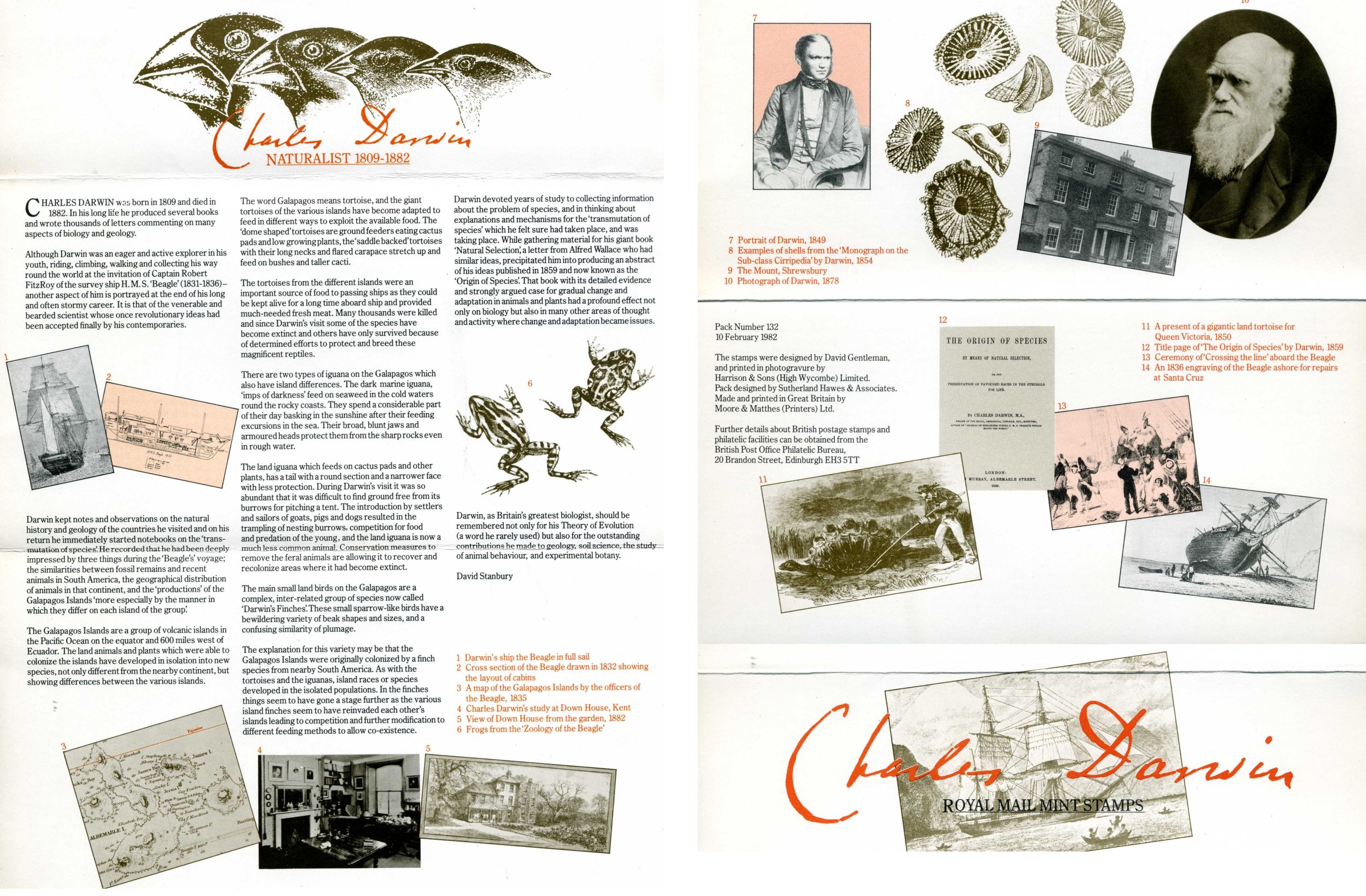
The following text is a quote from the Presentation Pack, written by David Stanbury
Charles Darwin was born in 1809 and died in 1882. In his long life he produced several books and wrote thousands of letters commenting on many aspects of biology and geology. Although Darwin was an eager and active explorer in his youth, riding, climbing, walking and collecting his way round the world at the invitation of Captain Robert Fitz Roy of the survey ship H. M. S. Beagle (1831-1836) - another aspect of him is portrayed at the end of his long and often stormy career. It is that of the venerable and bearded scientist whose once revolutionary ideas had been accepted finally by his contemporaries.
Darwin kept notes and observations on the natural history and geology of the countries he visited and on his return he immediately started notebooks on the "transmutation of species".
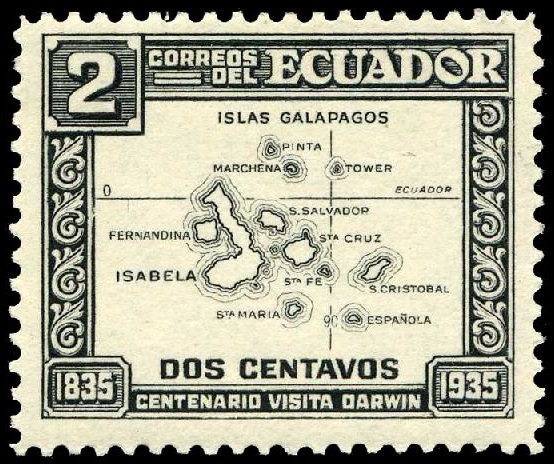
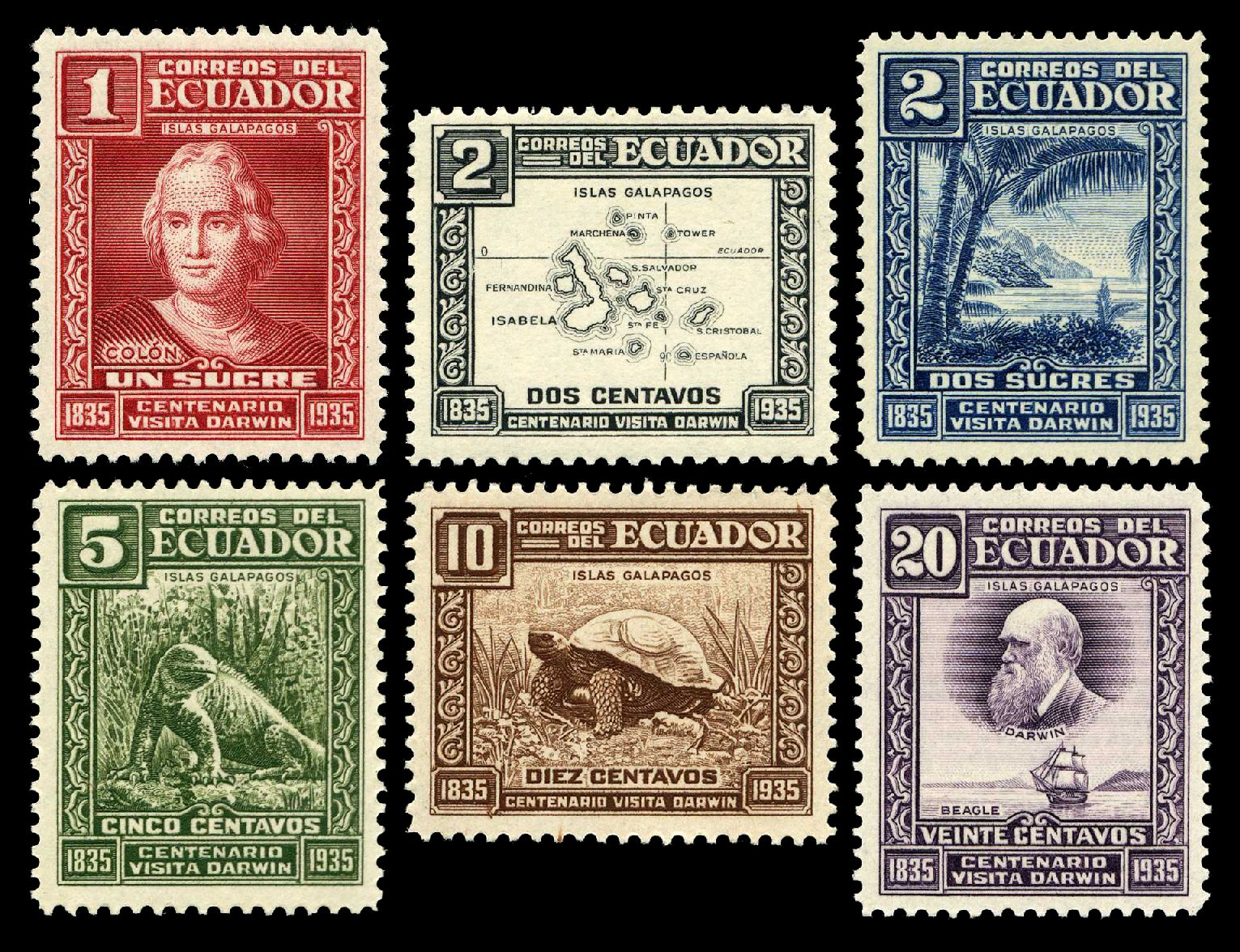
Map of Galapagos islands on stamp of Ecuador 1936. Part of the first stamp set depicting C. Darwin
He recorded that he had been deeply impressed by three things during the Beagles voyage; the similarities between fossil remains and recent animals in South America, the geographical distribution of animals in that continent, and the productions of the Galapagos Islands more especially by the manner in which they differ on each island of the group'.
The Galapagos Islands are a group of volcanic islands in the Pacific Ocean on the equator and 600 miles west of Ecuador. The land animals and plants which were able to colonize the islands have developed in isolation into new species, not only different from the nearby continent, but showing differences between the various islands.
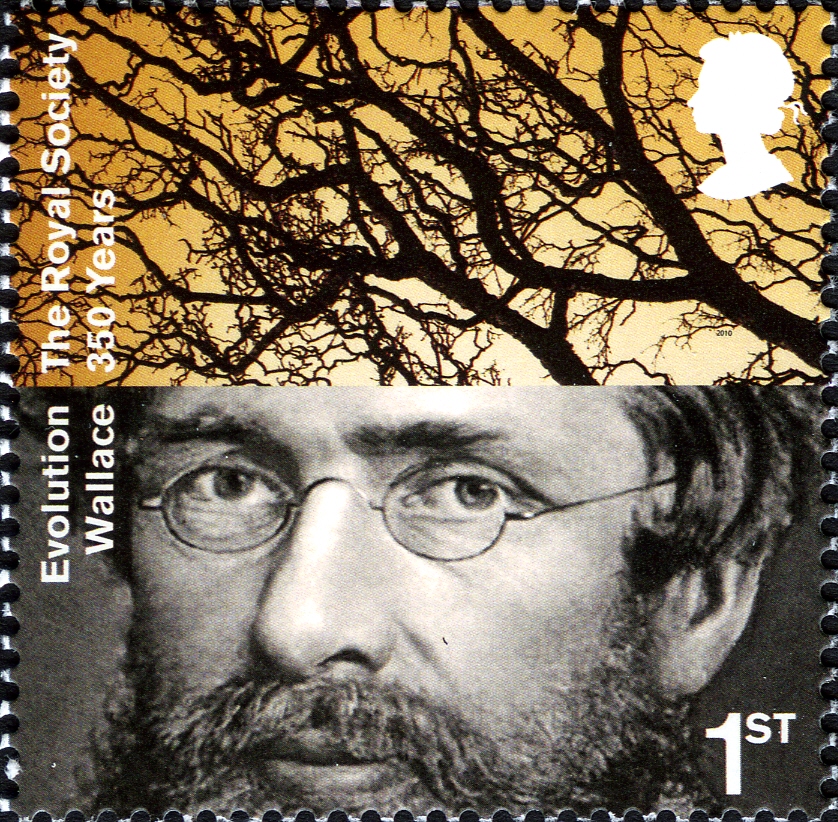
Darwin devoted years of study to collecting information about the problem of species, and in thinking about explanations and mechanisms for the transmutation of species which he felt sure had taken place, and was taking place. While gathering material for his giant book Natural Selection; a letter from Alfred Wallace who had similar ideas, precipitated him into producing an abstract of his ideas published in 1859 and now known as the Origin of Species!' That book with its detailed evidence and strongly argued case for gradual change and adaptation in animals and plants had a profound effect not only on biology but also in many other areas of thought and activity where change and adaptation became issues.
Alfred Wallace on stamp of UK 2010.
Darwin, as Britain's greatest biologist, should be remembered not only for his Theory of Evolution (a word he rarely used) but also for the outstanding contribution he made to geology, soil science, the study of animal behaviour, and experimental botany.
Giant Tortoises
The word Galapagos means tortoise, and the giant tortoises of the various islands have become adapted to feed in different ways to exploit the available food. The dome shaped' tortoises are ground feeders eating cactus pads and low growing plants, the 'saddle backed tortoises with their long necks and flared carapace stretch up and feed on bushes and taller cacti. The tortoises from the different islands were an important source of food to passing ships as they could be kept alive for a long time aboard ship and provided much-needed fresh meat. Many thousands were killed and since Darwin's visit some of the species have become extinct and others have only survived because of determined efforts to protect and breed these magnificent reptiles.
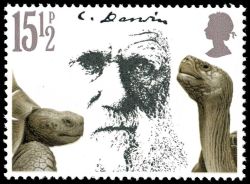
Giant Tortoises and Charles Darwin on stamp of UK 1982 MiNr.: ; Scott: .
Marine Iguanas
There are two types of iguana on the Galapagos which also have island differences. The dark marine iguana, 'imps of darkness feed on seaweed in the cold waters round the rocky coasts. They spend a considerable part of their day basking in the sunshine after their feeding excursions in the sea. Their broad, blunt jaws and armoured heads protect them from the sharp rocks even in rough water. The land iguana which feeds on cactus pads and other plants, has a tail with around section and a narrower face with less protection. During Darwin's visit it was so abundant that it was difficult to find ground free from its burrows for pitching a tent. The introduction by settlers and sailors of goats, pigs and dogs resulted in the trampling of nesting burrows, competition for food and predation of the young, and the land iguana is now a much less common animal. Conservation measure to remove the feral animals are allowing it to recover and recolonize areas where it had become extinct.
Marine Iguanas and Charles Darwin on stamp of UK 1982
Cactus Ground Finch and Large Ground Finch
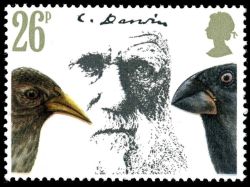
Cactus Ground Finch, Large Ground Finch and Charles Darwin on stamp of UK 1982 MiNr.: ; Scott: .
The main small land birds on the Galapagos are a complex, inter-related group of species now called Darwin's Finches' These small sparrow-like birds have a bewildering variety of beak shapes and sizes, and a confusing similarity of plumage. The explanation for this variety may be that the Galapagos Islands were originally colonized by a finch species from nearby South America. As with the tortoises and the iguanas, island races or species developed in the isolated populations. In the finches things seem to have gone a stage further as the various island finches seem to have reinvaded each other's islands leading to competition and further modification to different feeding methods to allow co-existence
The fourth stamp of the set - Prehistoric Skulls, was not described in the presentation pack.
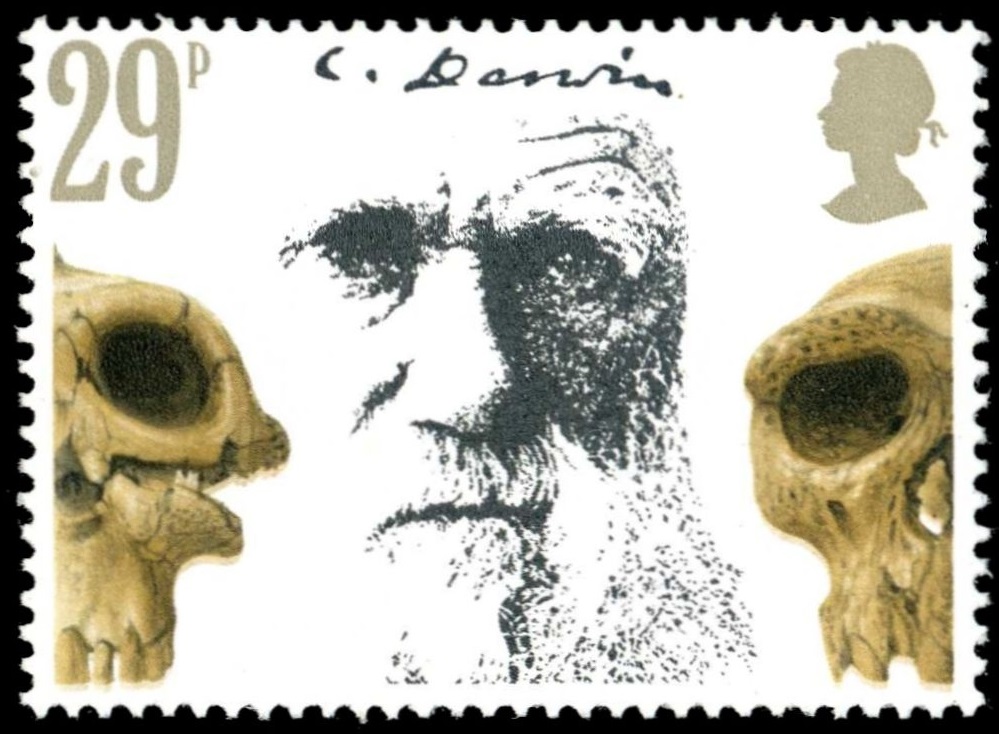 |
| Prehistoric Skulls and Charles Darwin on stamp of UK 1982 |
These species represent important stages in human evolution, visually reinforcing Darwin’s ideas about the gradual development of life forms over time. Although Darwin himself did not write extensively about human evolution in On the Origin of Species, his later work, The Descent of Man (1871), explicitly addressed the evolutionary origins of humans.
Products and associated philatelic items
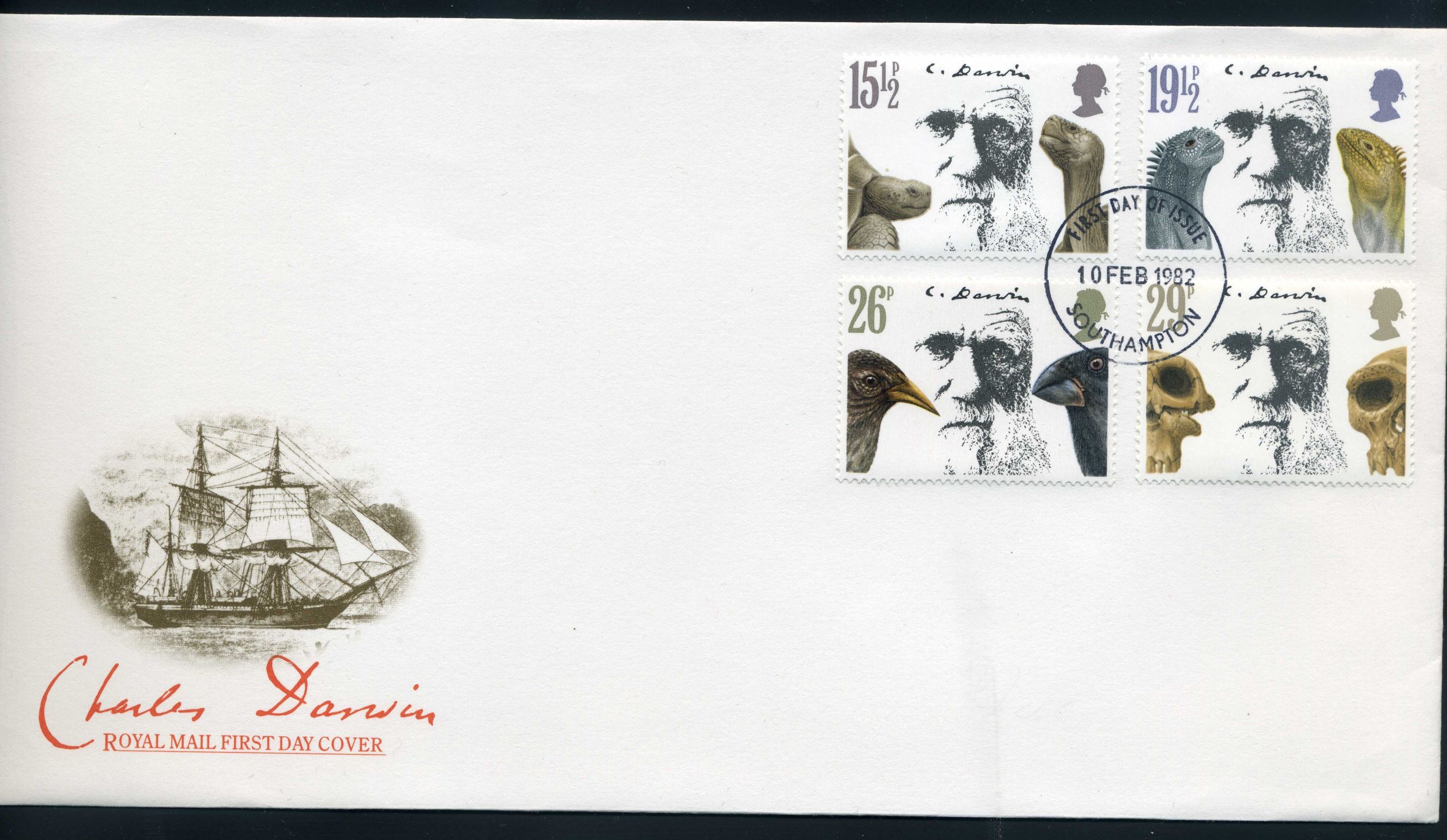
| Official and some personalized FDC | Example of Circulated Cover | |
 |
 |

|
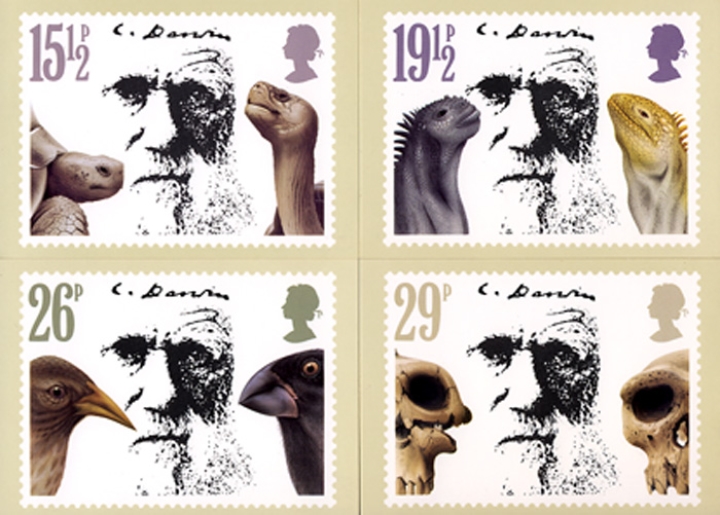
| Presentation Pack | Post Cards | |
 |
 |
|
References
Wikipedia, BFDC, Inside pages of FDC, and Presentation Pack.
Acknowledgements
Many thanks to Dr. Peter Voice from Department of Geological and Environmental Sciences, Western Michigan University, for reviewing the draft page and his very valuable comments.