Romania 2026 "Prehistoric Animals"
| Issue Date | 27.08.2026 |
| ID | Michel: ; Scott: ; Stanley Gibbons: Yvert et Tellier: ; Category: pR |
| Designer | Mihaela ENE |
| Stamps in set | 4 |
| Value |
3.00L - Deinotherium proavum 5.50L - Ursus spelaeus> 6.50L - Megaloceros giganteus 32.0L - Macrospondylus bollensis |
| Size (width x height) | stamps: 63 mm x 27mm, Mini-Sheet: 140 mm x 100 mm |
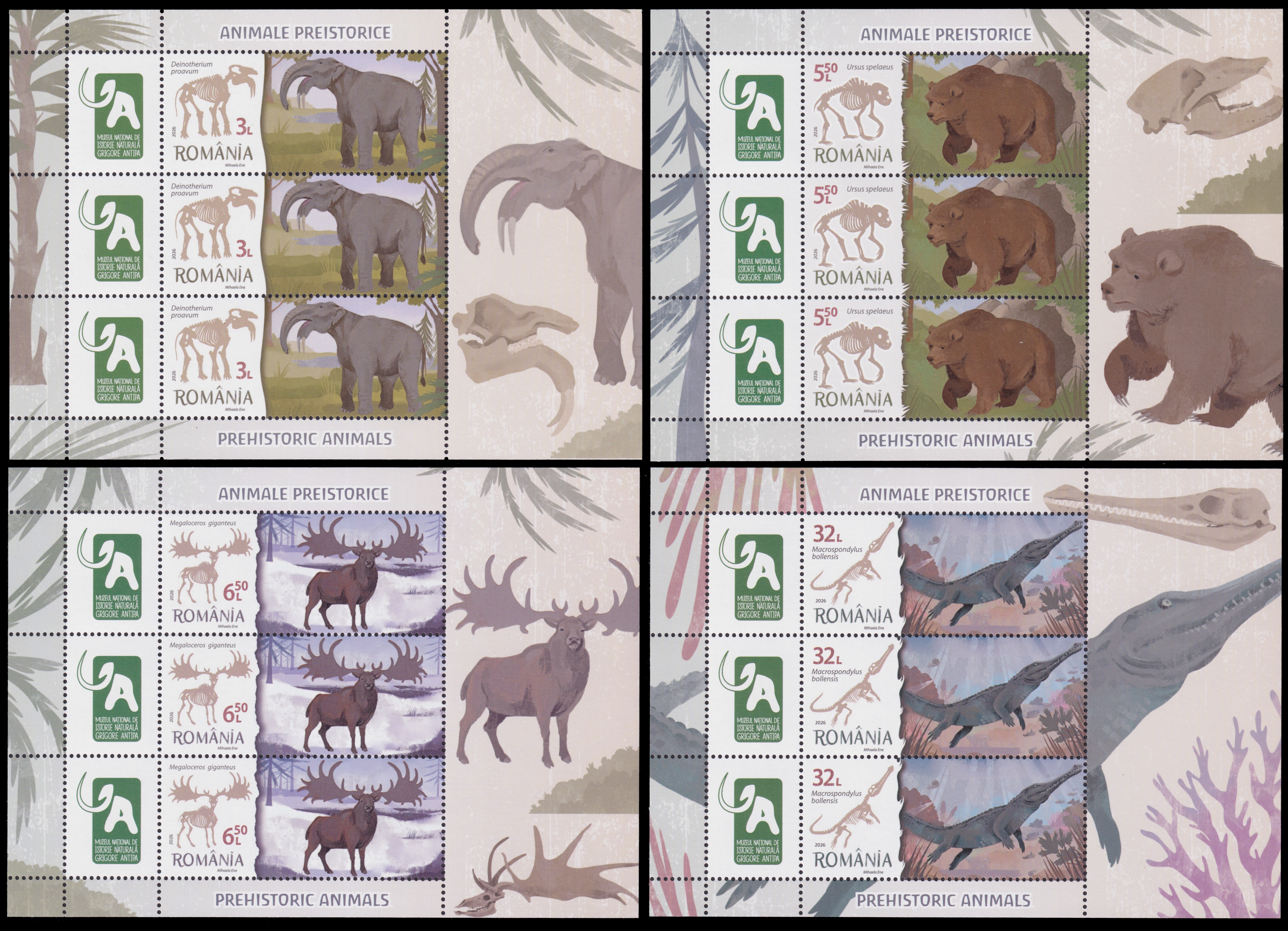
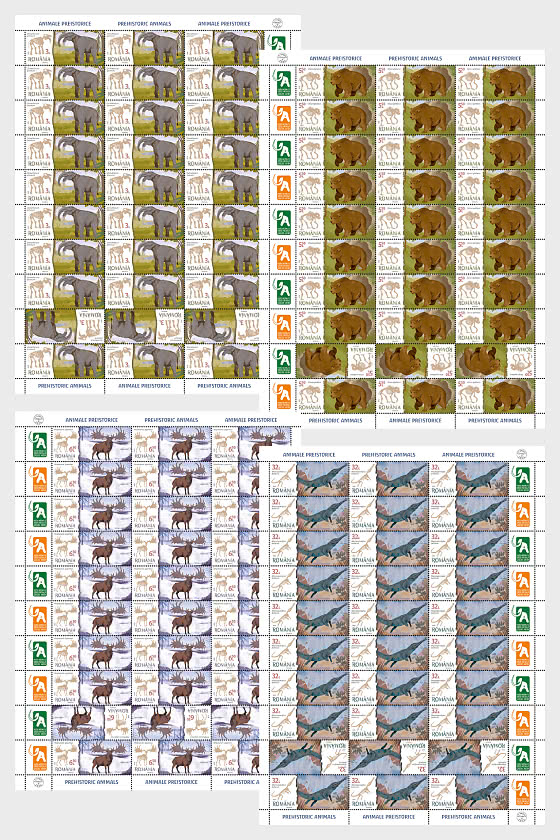
| Layout | Four Mini Sheets of 3 with 3 labels, Sheets of 30 with 19 labels. |
| Products | FDC x1, MS x5, Souvenir Folder |
| Paper | gummed, produced by Tullis Russel, UK, weight 112 +- 4% g/m2 |
| Perforation | 13.25 x 13.25 |
| Print Technique | Offset lithography, 5 colours (4 + 1 UV) |
| Printed by | |
| Quantity |
Total 35,004 stamps:
|
| Issuing Authority | SC Romfilatelia SA |
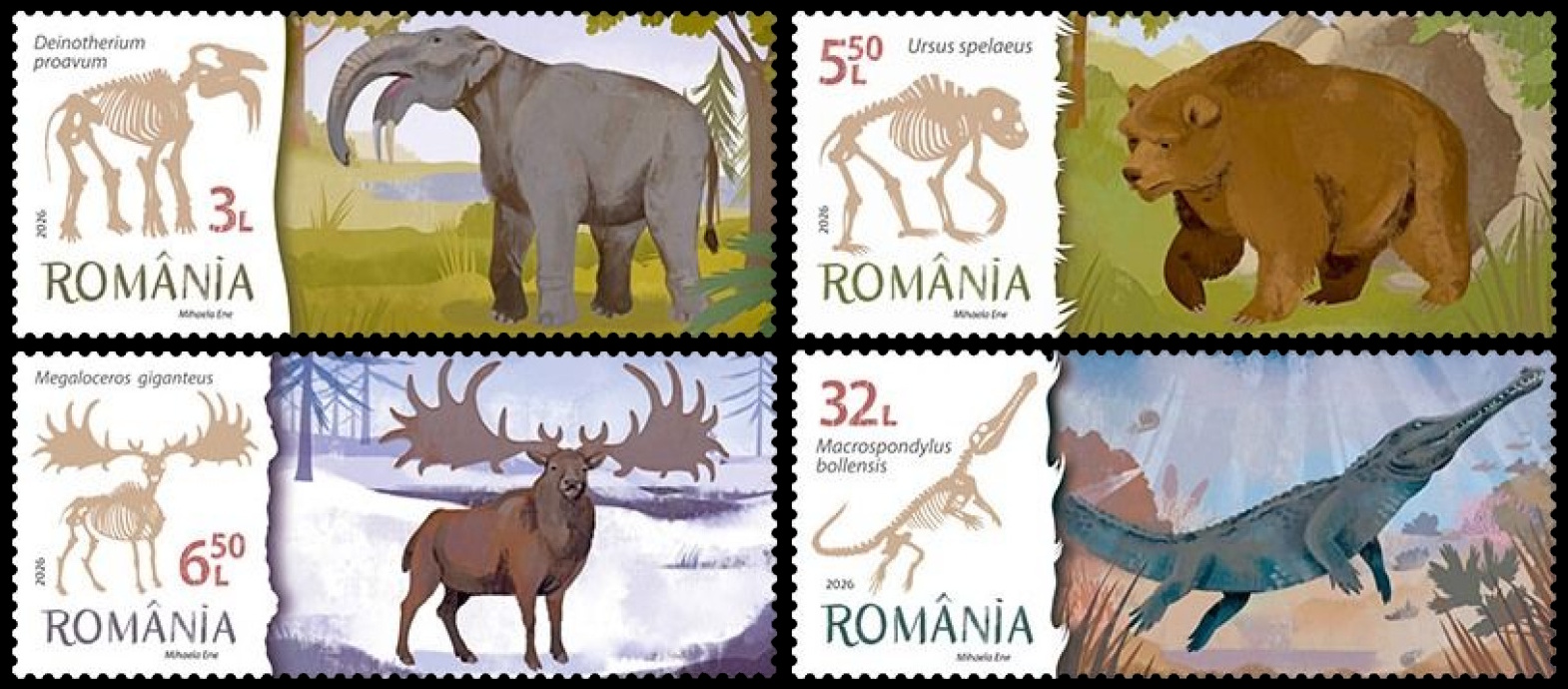
On August 27th, 2026, the Romanian Post Authority, in cooperation with the “Grigore Antipa” National Museum of Natural History, issued a set of four stamps entitled “Prehistoric Animals”.
The stamps feature prehistoric animals from the museum’s collection and invite viewers to look beyond the present, discovering the extraordinary diversity of life that inhabited our planet throughout the geological ages.
As has become common with recent Romanian commemorative stamp issues, the set includes one stamp whose face value is more than double the combined face value of the other three stamps, making the set rather expensive.
To generate additional revenue from collectors, the Romanian Post Authority produced several variants of these stamps:
- mini-sheets of three stamps
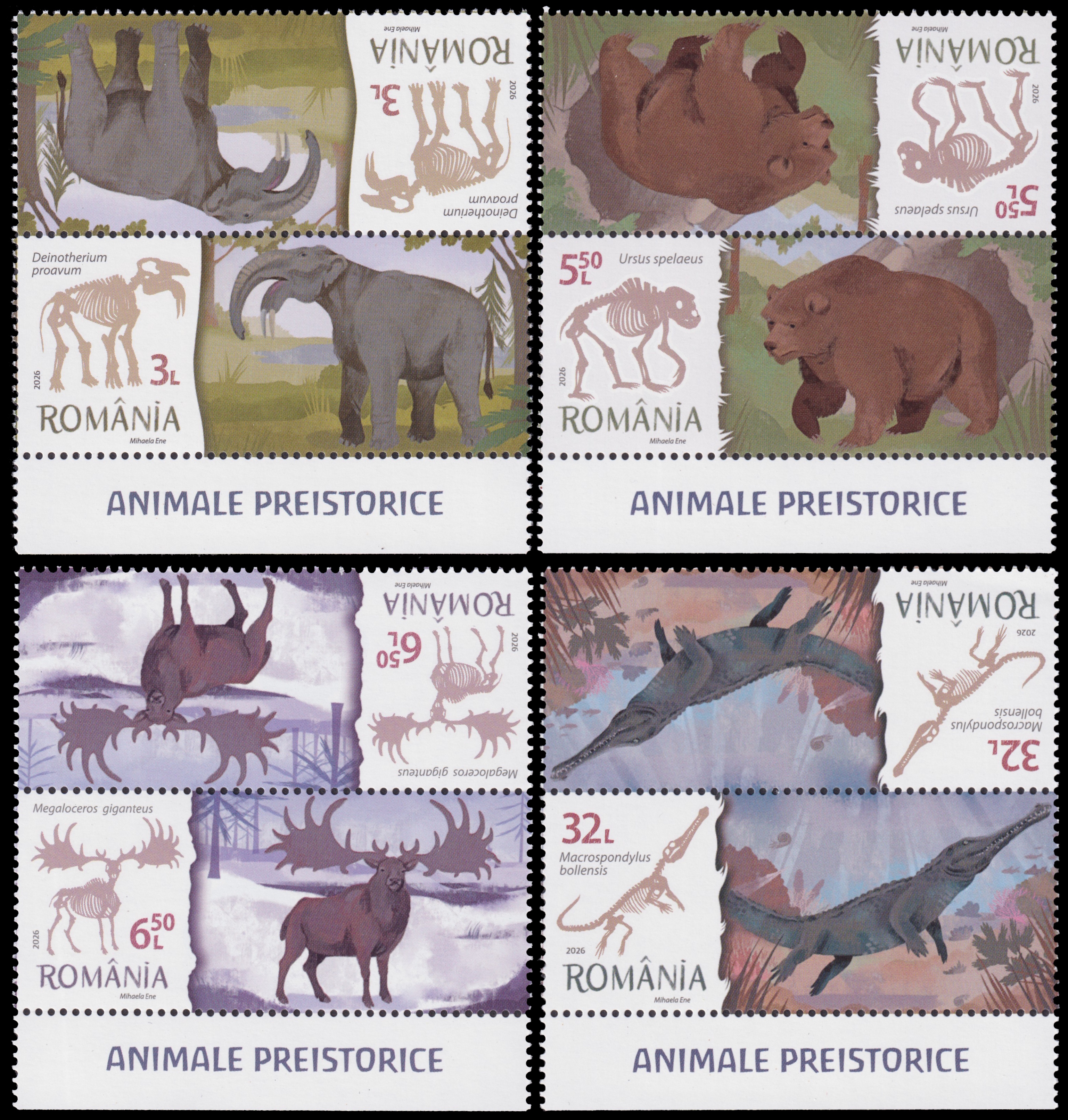
- sheets of 30 stamps in which every second row has a tab of a different colour, and stamps in the last two rows printed as tête-bêche pairs
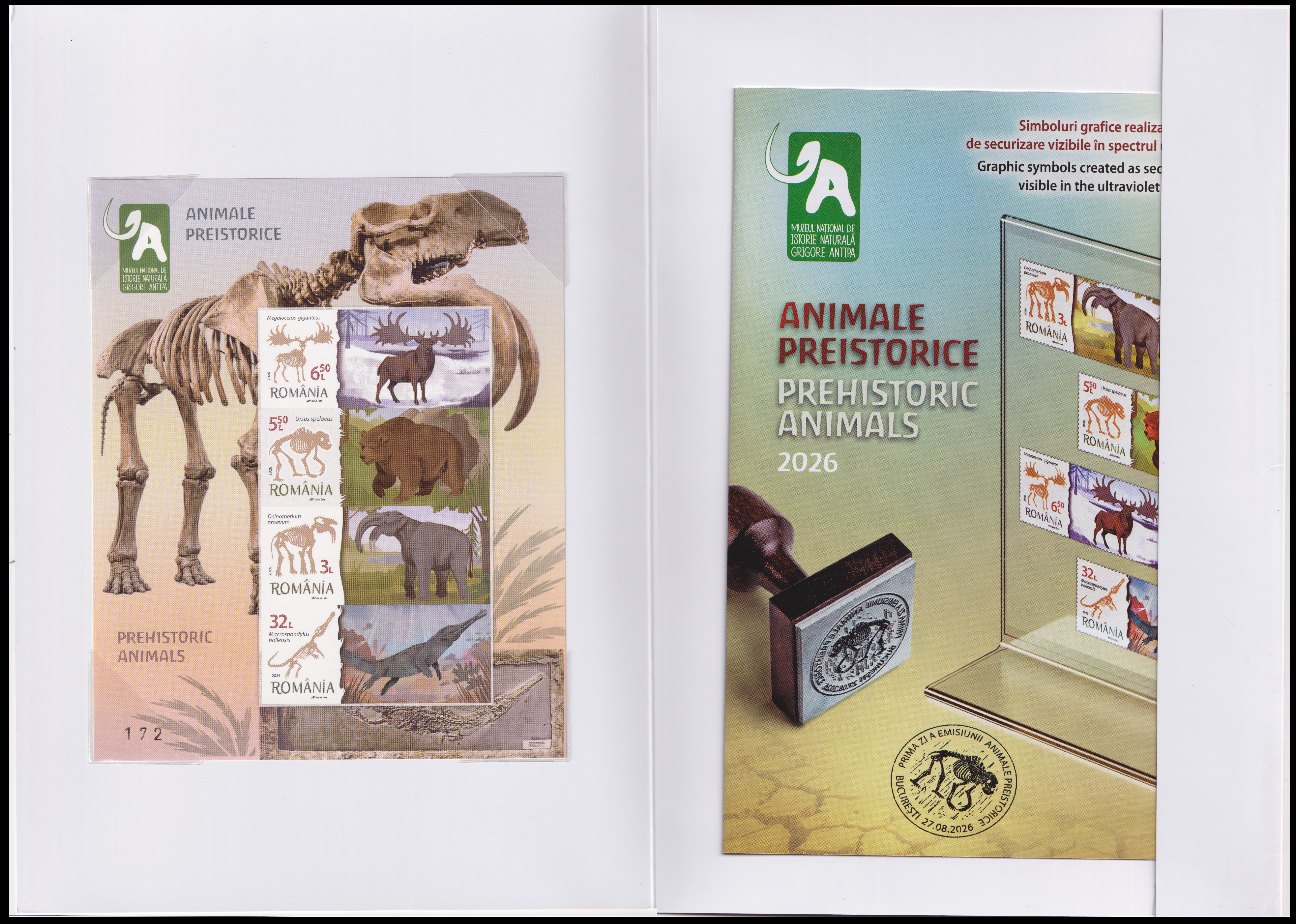
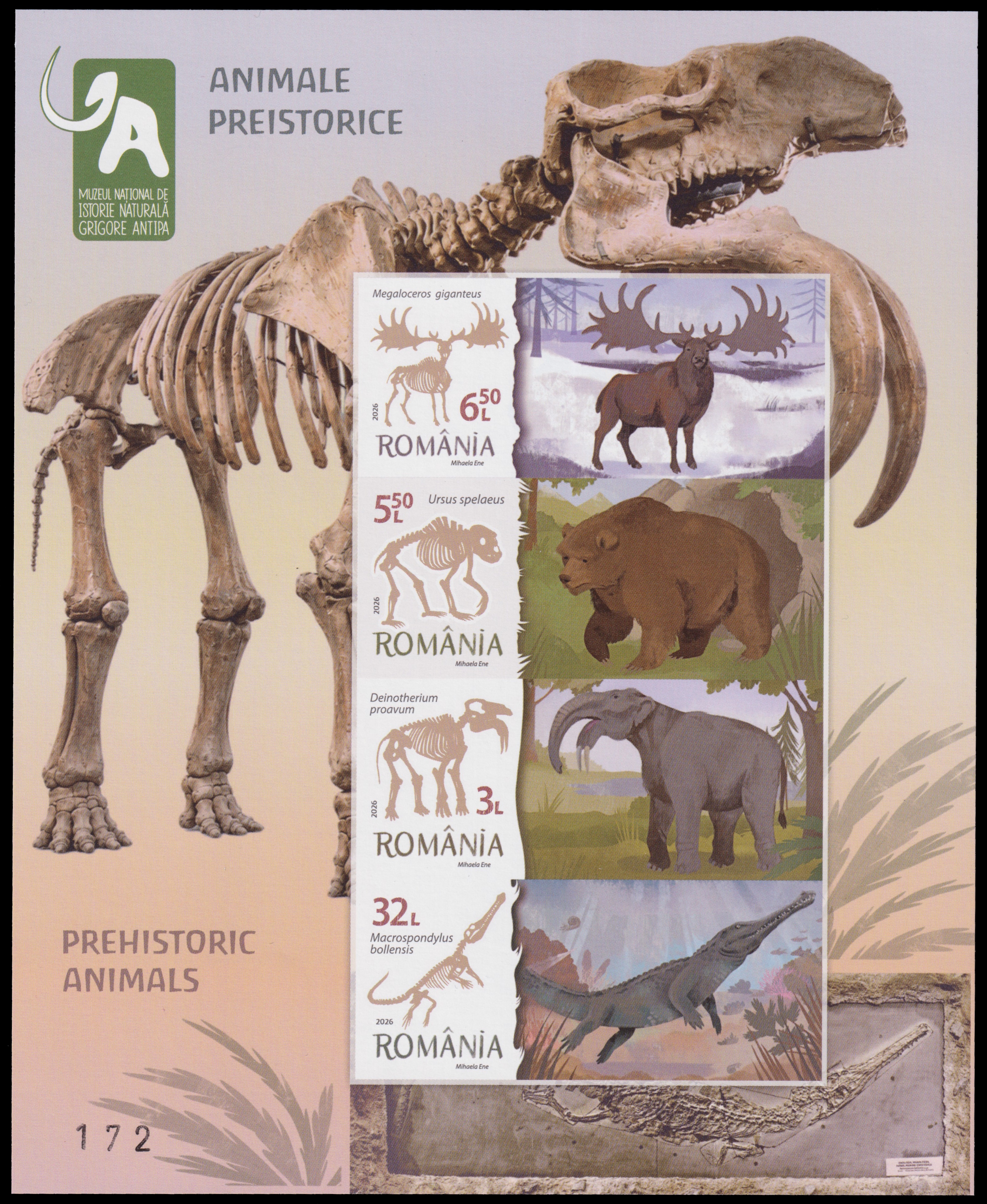
- souvenir folder with imperforate, numbered mini sheet
The following text was published on the website of Romfilatelia in 2026 and in the brochure included in the souvenir folder
Before the world took on the form we know today, the Earth was inhabited by spectacular creatures, some of them of impressive size, all adapted to environments that disappeared long ago. Time has transformed their existence into fossils, and these fossils, like pages preserved in a vast archive of nature, help us today to piece together fragments of the history of life on Terra.
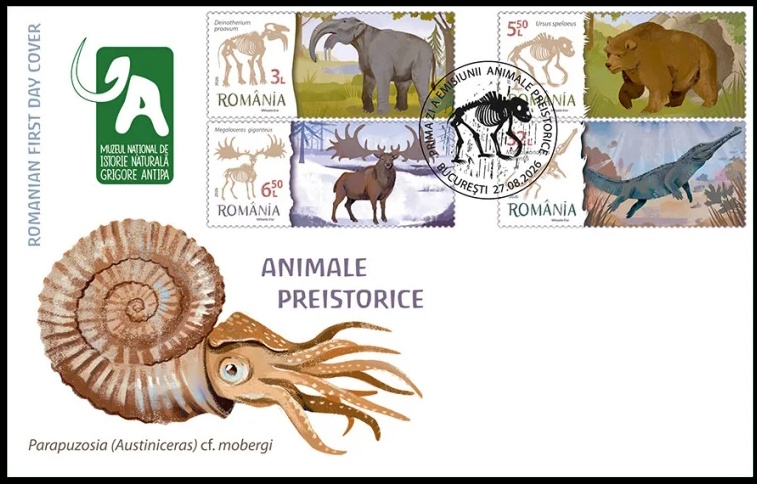
A glimpse into this fascinating world is offered by the postage stamp issue ‘Prehistoric Animals’, in which the science of palaeontology meets the art of postal miniature. From the imposing Deinotherium proavum, one of the largest proboscideans ever to have existed, and the cave bear Ursus spelaeus, to the spectacular Megaloceros giganteus, the marine crocodylomorph Macrospondylus bollensis, and the ammonites of the Cretaceous seas, each image evokes a page from a history that began millions of years ago.
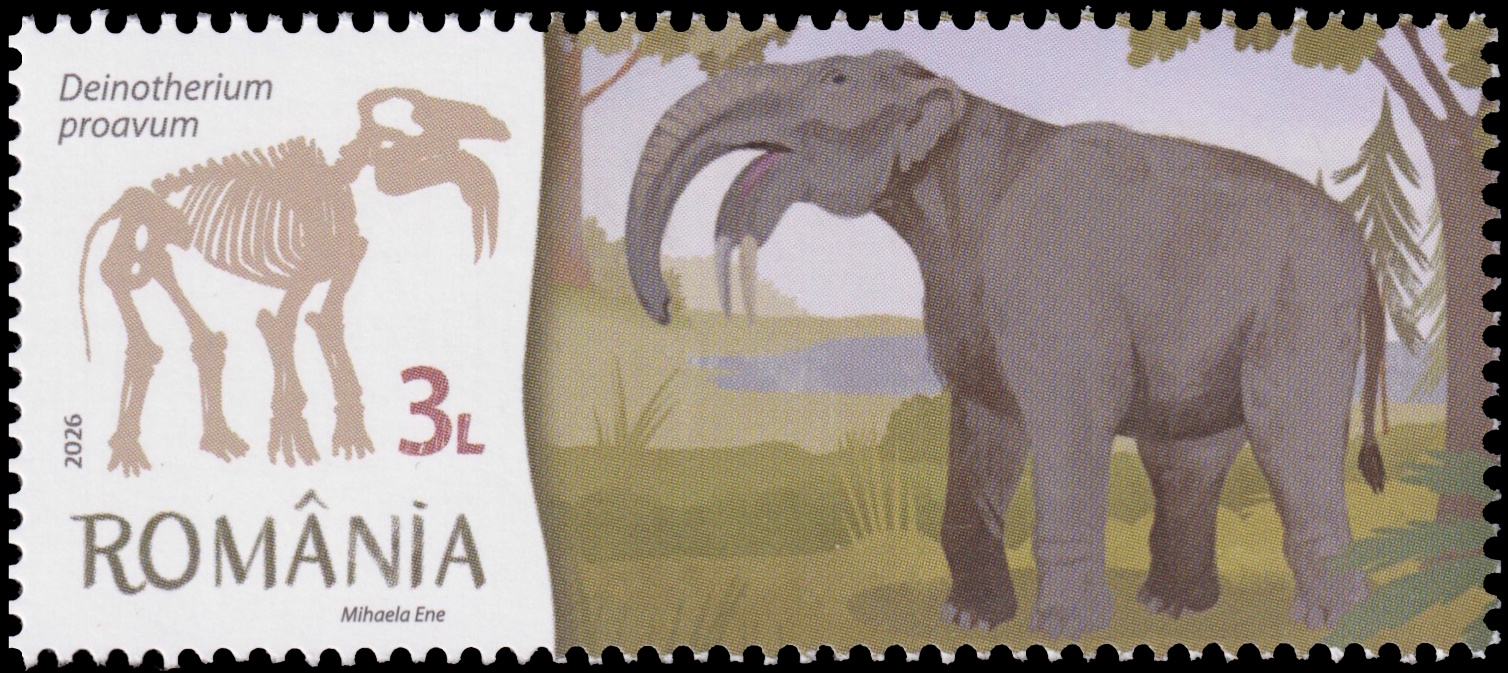
Deinotherium proavum
The large fossil proboscidean skeleton on display in the Museum’s atrium is commonly known as Deinotherium gigantissimum, the name under which it was described by its discoverer, the Romanian palaeontologist Gregoriu Ștefănescu. Over time, however, it has been observed that the differences between Deinotherium gigantissimum and another, previously described fossil species, Deinotherium proavum, are very slight. Consequently, most palaeontologists now consider Deinotherium gigantissimum to represent a local form of Deinotherium proavum, rather than a distinct species.
Deinotherium proavum on stamp of Romania 2026
Unlike many other species of proboscideans (‘elephants’ in the broad sense), Deinotherium had its ‘tusks’ on the lower jaw, not on the upper jaw; they curved downwards. Deinotherium proavum is among the largest proboscidean species of all time, exceeding 4 m in height at the withers and reaching an estimated weight of 10-14 tonnes. It lived in eastern and southern Europe between 9 and 6-7 million years ago, in habitats believed to have been wet forests.
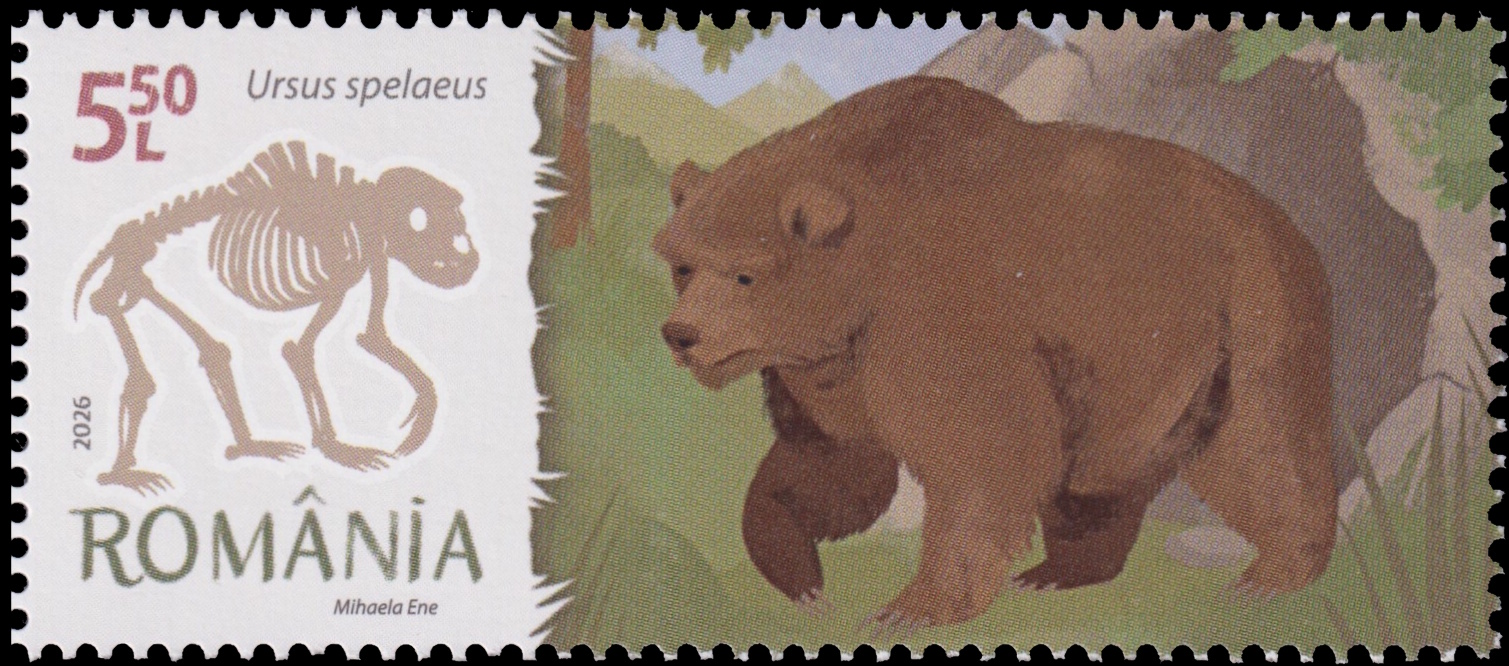
Ursus spelaeus
The cave bear lived between 250,000 and 24,000 years ago in Europe (including Romania, where the skeleton on display comes from) and in some regions of Asia. It lived during the Quaternary Period, through both glacial and interglacial periods. It was large in stature (up to 2 metres in length; males weighed up to 600 kg, females up to 250 kg), with a more massive head, a more rounded forehead and a shorter snout than the brown bear. It lived in mountainous areas and took shelter in caves. It was omnivorous and co-existed with humans as they settled in Europe; it appears that humans hunted it. It is depicted in the cave paintings of the Chauvet (France) and Coliboaia (Romania) caves, dating from approximately 30,000-35,000 years ago. Its extinction was due to multiple factors, including the maximum expansion of the glaciers, but also, possibly, hunting by humans.
Ursus spelaeus (cave bear) on stamp of Romania 2026
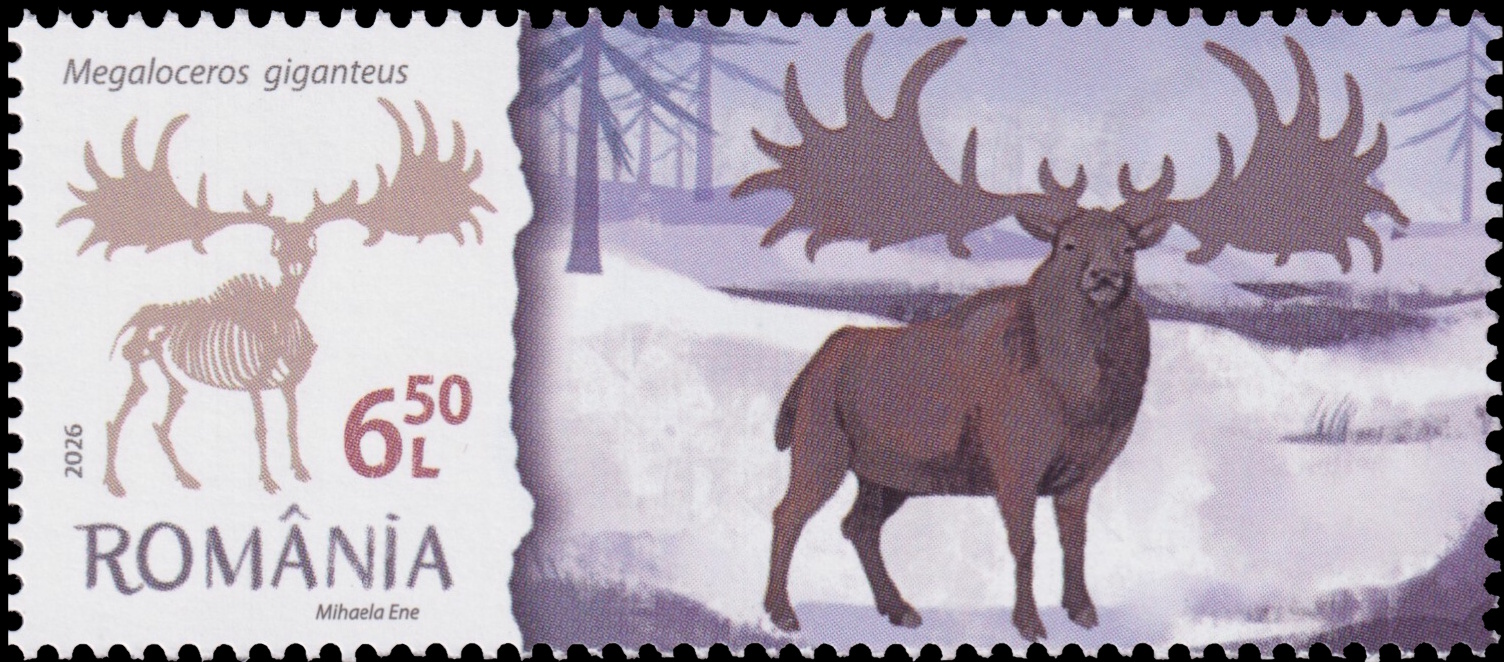
Megaloceros giganteus
The giant deer, or Irish elk (first discovered in Ireland, where many skeletons have been found, including the one displayed in the Museum), lived in Europe and Siberia from approximately 425,000 years ago to around 7,600 years ago. The male stood 2 m at the withers and bore palmate antlers with a span of up to 4 m; the female was smaller and did not have antlers. It inhabited open woodland with wetlands. Like the cave bear, the giant deer was hunted by humans, was depicted in cave art, and became extinct as a result of multiple factors of a similar nature, albeit much later.
Megaloceros giganteus (giant deer) on stamp of Romania 2026
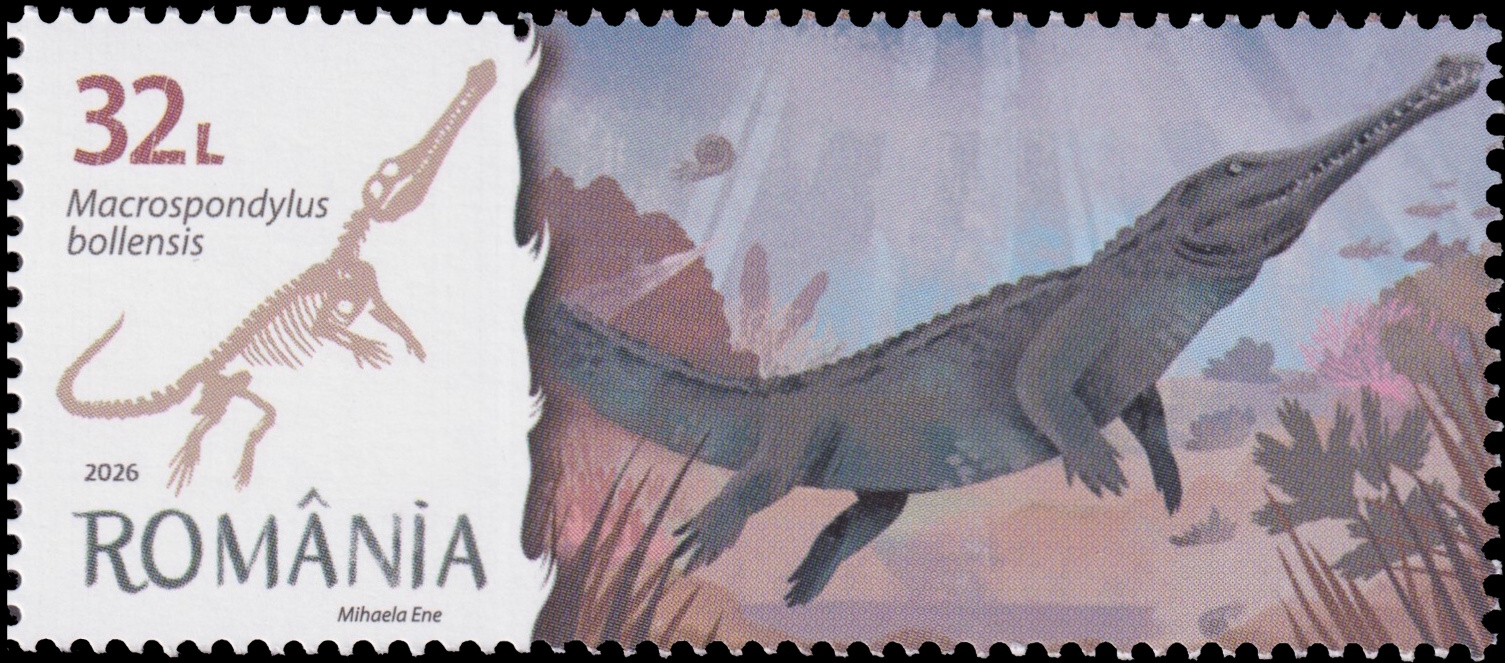
Macrospondylus bollensis
This species of ‘crocodile’ (actually a crocodylomorph belonging to a broader group) lived during the Early Jurassic, around 183-180 million years ago, alongside numerous dinosaurs. It inhabited shallow marine waters, coming ashore to lay its eggs (it was probably oviparous). It is known from sites in the United Kingdom, Luxembourg, and, in particular, Germany, where hundreds of specimens are known, including the one on display.
Macrospondylus bollensis (‘crocodile’) on stamp of Romania 2026
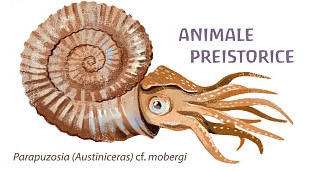
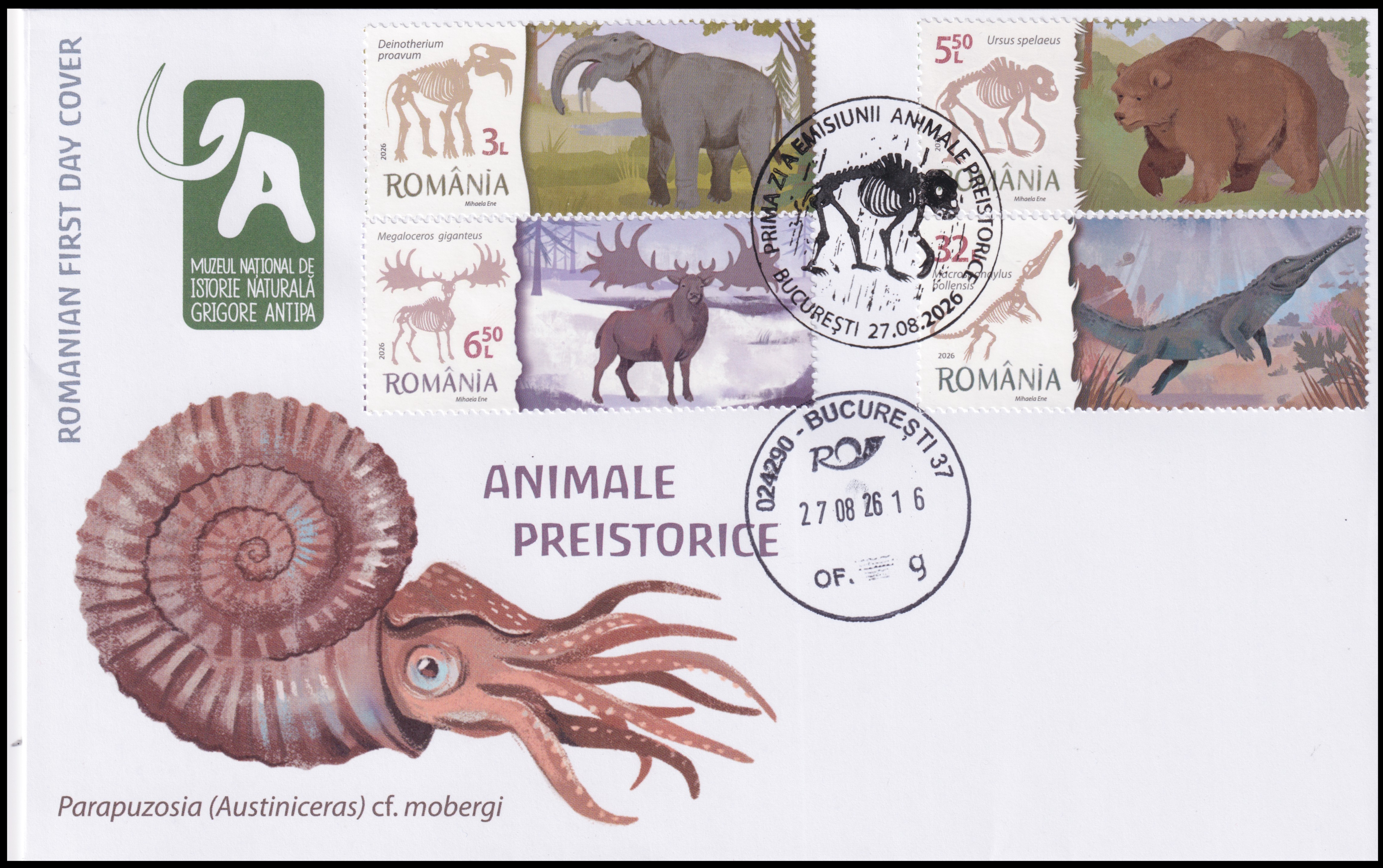
Parapuzosia (Austiniceras) cf. mobergi (depicted on the First Day Cover of the issue)
This species is an ammonite – a member of a group of marine cephalopods with a shell that is most often spiral-shaped. They lived from the Devonian period (around 400 million years ago) until the Cretaceous-Palaeogene boundary, when the ammonites appear to have become extinct as a result of the same global event as the dinosaurs. Ammonite shells are well known and described, but very little is known about their soft parts (organs, tentacles); it is only very recently (2021) that such remains have been described. Ammonites fed by filtering plankton or capturing various small prey, and were themselves preyed upon by marine reptiles. The specimen on display dates from the Late Cretaceous (probably around 96–84 million years ago) and originates from Romania (Dobrogea). It belongs to a large-bodied genus that also includes the largest ammonite known to date, Parapuzosia sepenradensis, which reaches 2 m in diameter. The specimen on display is of a more modest size.
Ammonite on a cachet of FDC Romania 2026
Products and associated philatelic items
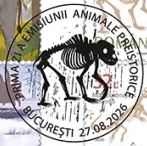
| FDC | First-Day-of-Issue Postmark | Mini-Sheets |
 |
 |
 |
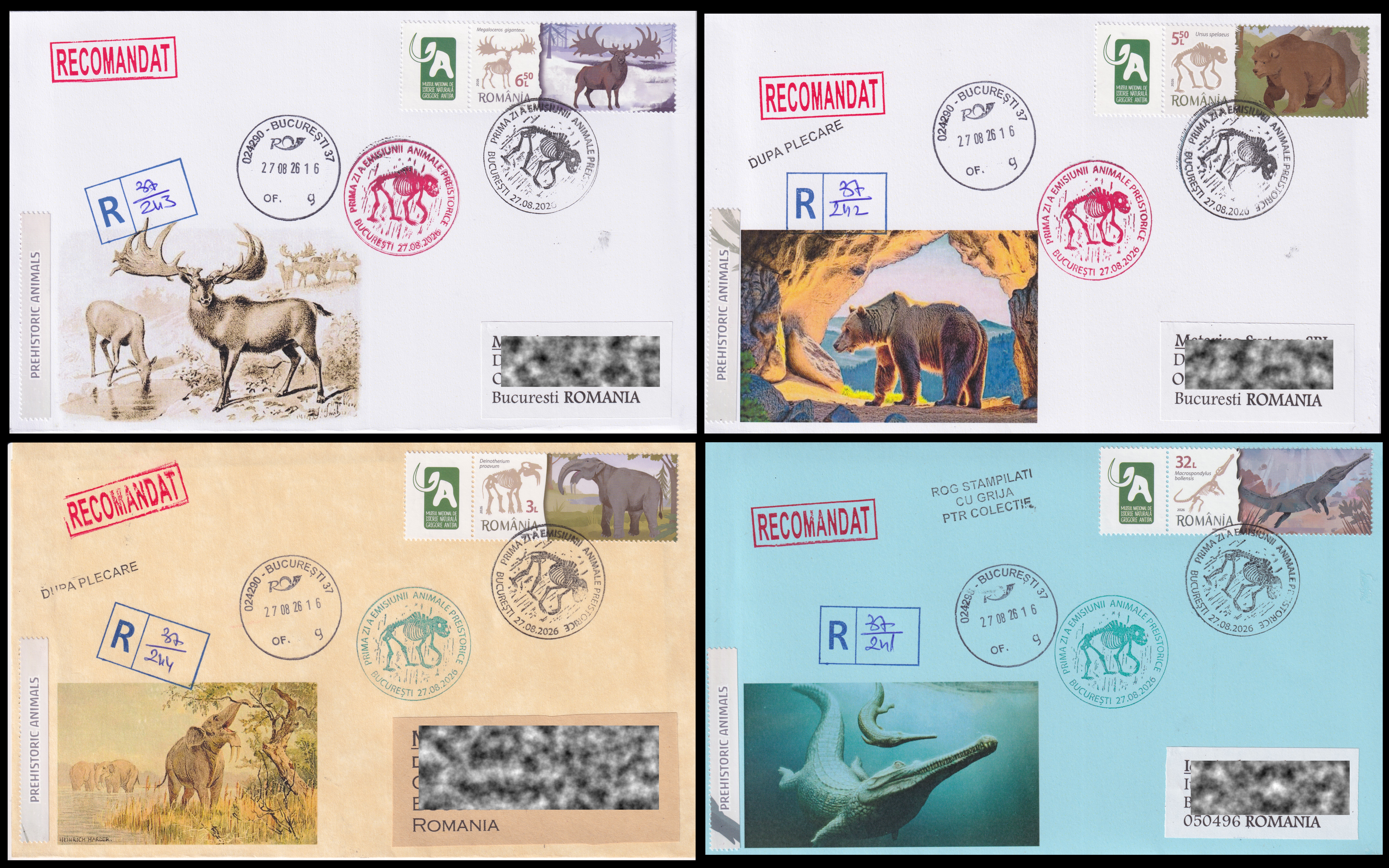
| Circulated FDC (official and personalized) | Sheets | |
 |
 |
 |
| Souvenir Folder with imperforate Mini-Sheet | Tete-beshe stamps from the sheets of 30 | |
 |
 |
 |
References
- Technical details and short description:
Romfilatelia (Brochure from the souvenir-folder).