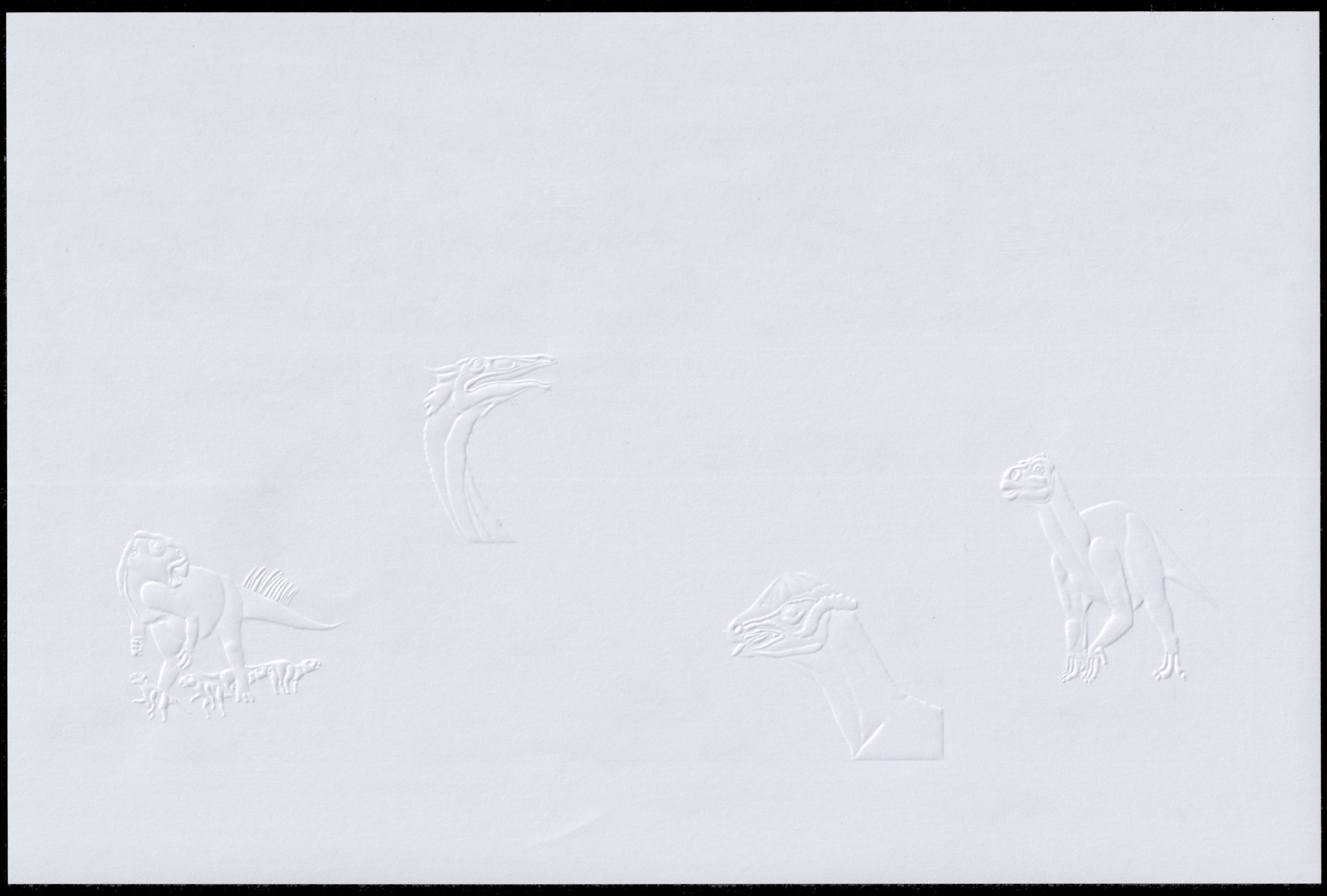
offset lithography combined with PMS 357 special ink,
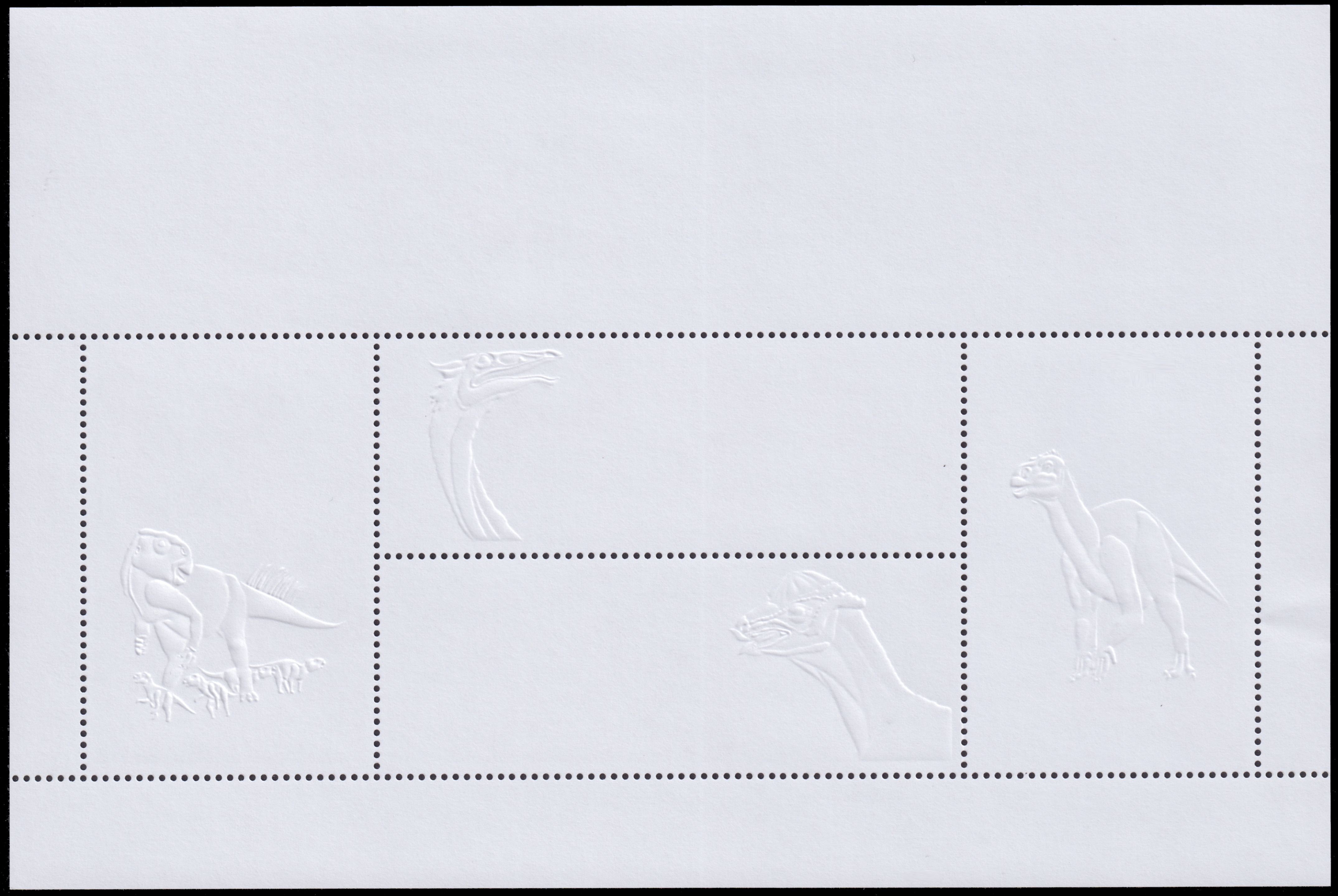
embossed stamps
Printed by
Quantity
Mini-Sheets: ?,
FDC 350.
Issuing Authority
Mongol Post Company
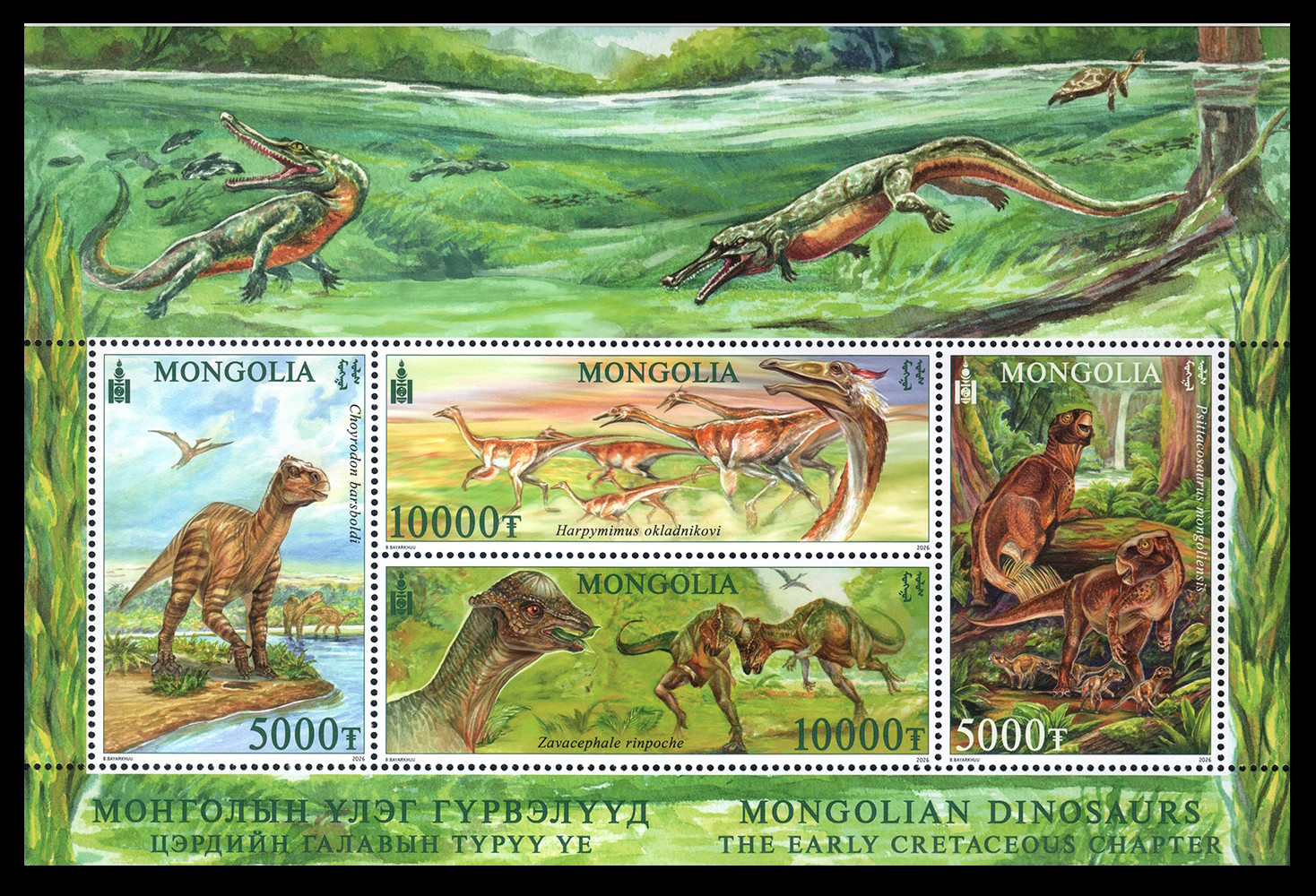
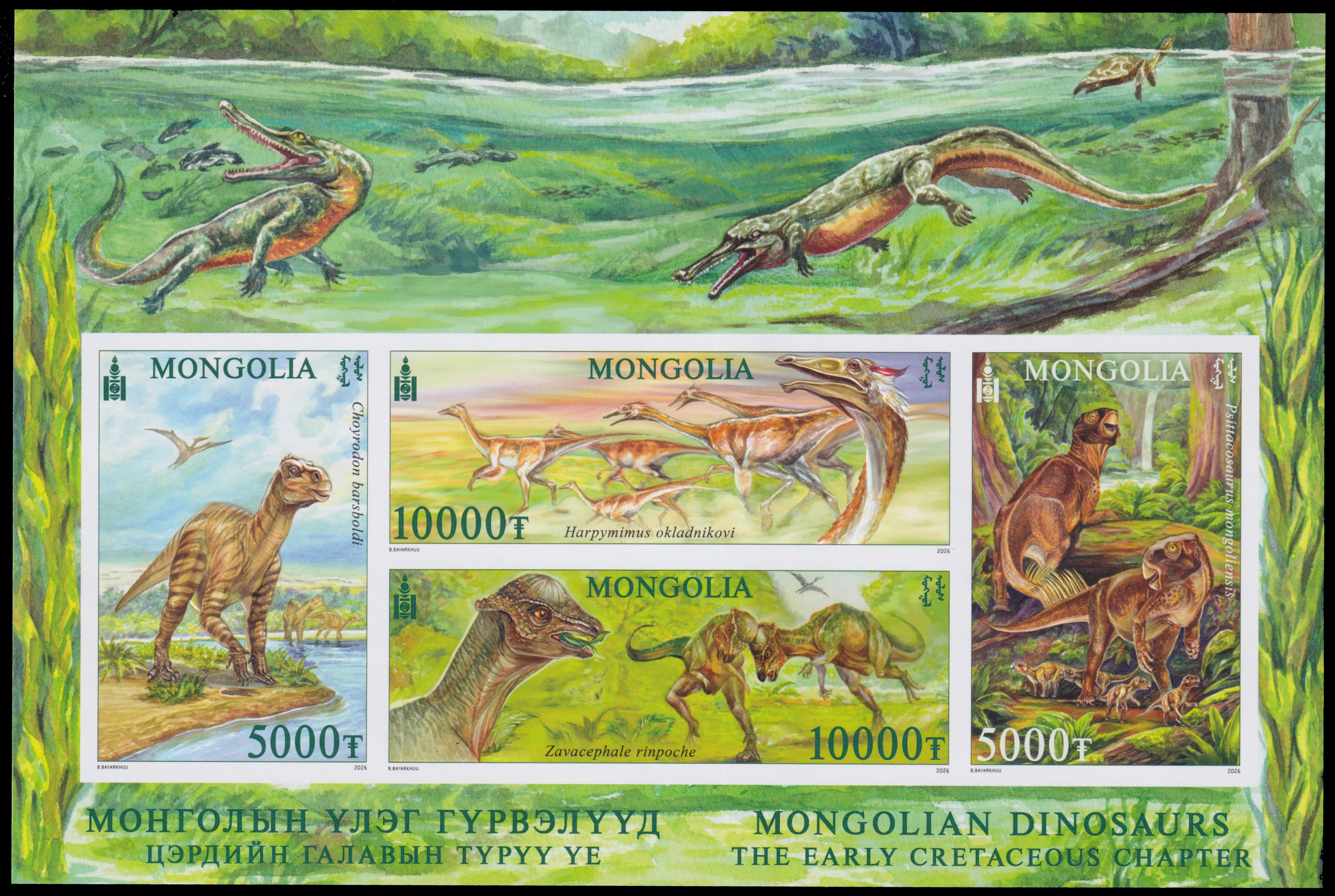
On June 24th, 2026, the Post Authority of Mongolia issued a miniature sheet of four
embossed stamps
entitled "Mongolian Dinosaurs – The Early Cretaceous"
(inscribed on the bottom-right "Mongolian Dinosaurs the Early Cretaceous Chapter" and in Mongolian on bottom-left).
The issue depicts four dinosaur species discovered in Mongolia that lived during the Early Cretaceous,
approximately 145–100 million years ago.
Their fossils provide important insights into the evolution of herbivorous and carnivorous dinosaurs following
the end of the Jurassic and demonstrate the remarkable diversity of Mongolia's prehistoric ecosystems.
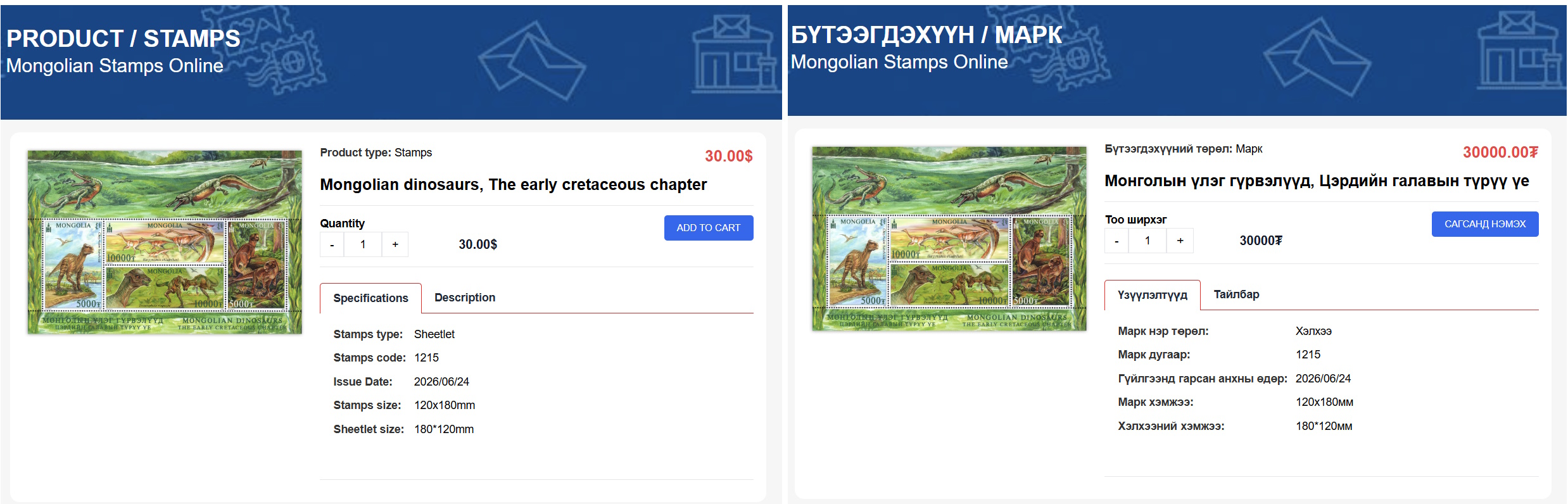
It was less expensive to purchase the stamps from international dealers than to order them directly from the Mongolian
Post online store.
The perforated miniature sheet was offered to foreign customers through the official online store for
USD 30, whereas several dealers listed it for approximately USD 20.
The face value of the miniature sheet, however, was only 30,000 MNT, equivalent to about USD 8.40 at the time of issue.
Mongolian customers, on the other hand, could purchase the stamps through the Mongolian Post online store at face value.
Screenshot from the Mongolian Post online store, accessed on July 8th, 2026.
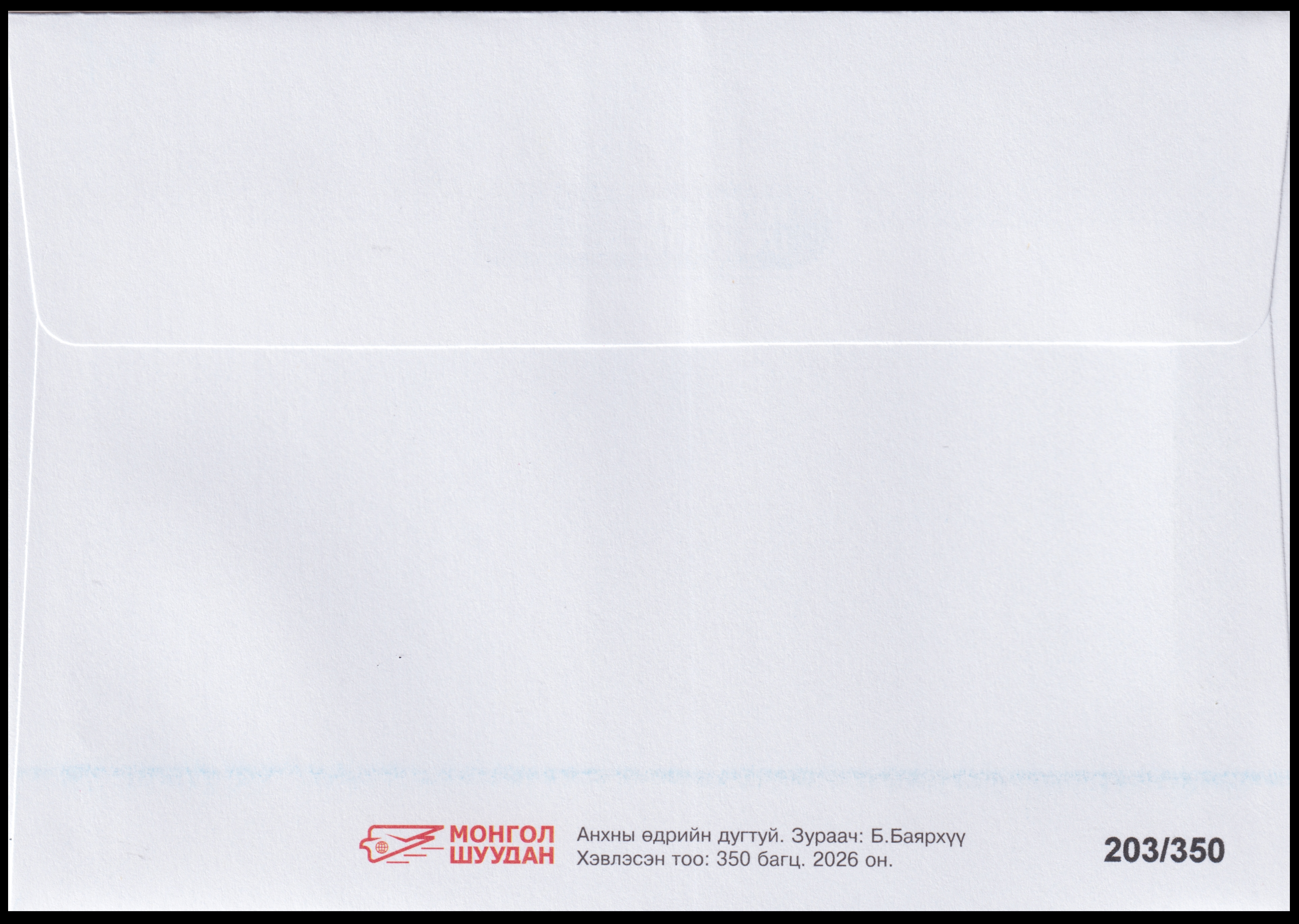
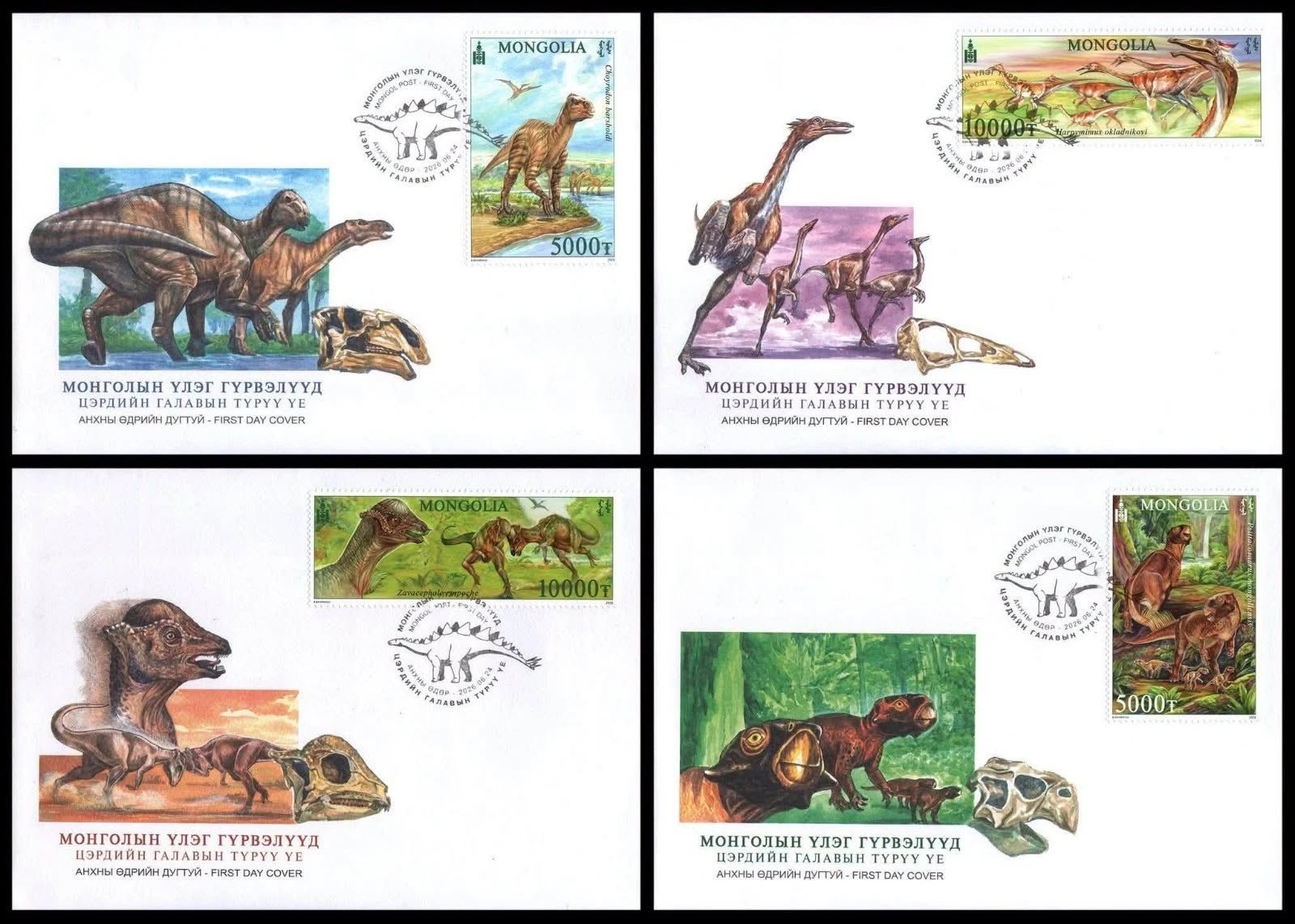
According to one Mongolian stamp dealer, sales of the official first-day cover (FDC) were limited to a maximum of three
sets per customer because
only 350 FDC sets were reportedly produced.
Neither the FDC nor the set of maximum cards was offered through the Mongolian Post online store.
Reflecting this apparent scarcity, complete FDC sets soon appeared on eBay with asking
prices of up to USD 100, while the set of maximum cards was offered for as much as USD 50.
Mongolia is one of the world's most important regions for dinosaur paleontology.
Since the first Central Asiatic Expeditions of the 1920s, followed by numerous Mongolian,
Soviet, Polish, Japanese, Korean, Chinese, and other international expeditions,
hundreds of dinosaur specimens representing more than one hundred species have been discovered in the Gobi Desert.
Many of these fossils are exceptionally well preserved, including complete skeletons, nests, eggs, feather impressions,
and even traces of soft tissues, making Mongolia a cornerstone for understanding dinosaur evolution.
The four dinosaurs depicted on this miniature sheet represent the remarkable diversity of Mongolia's Early Cretaceous fauna.
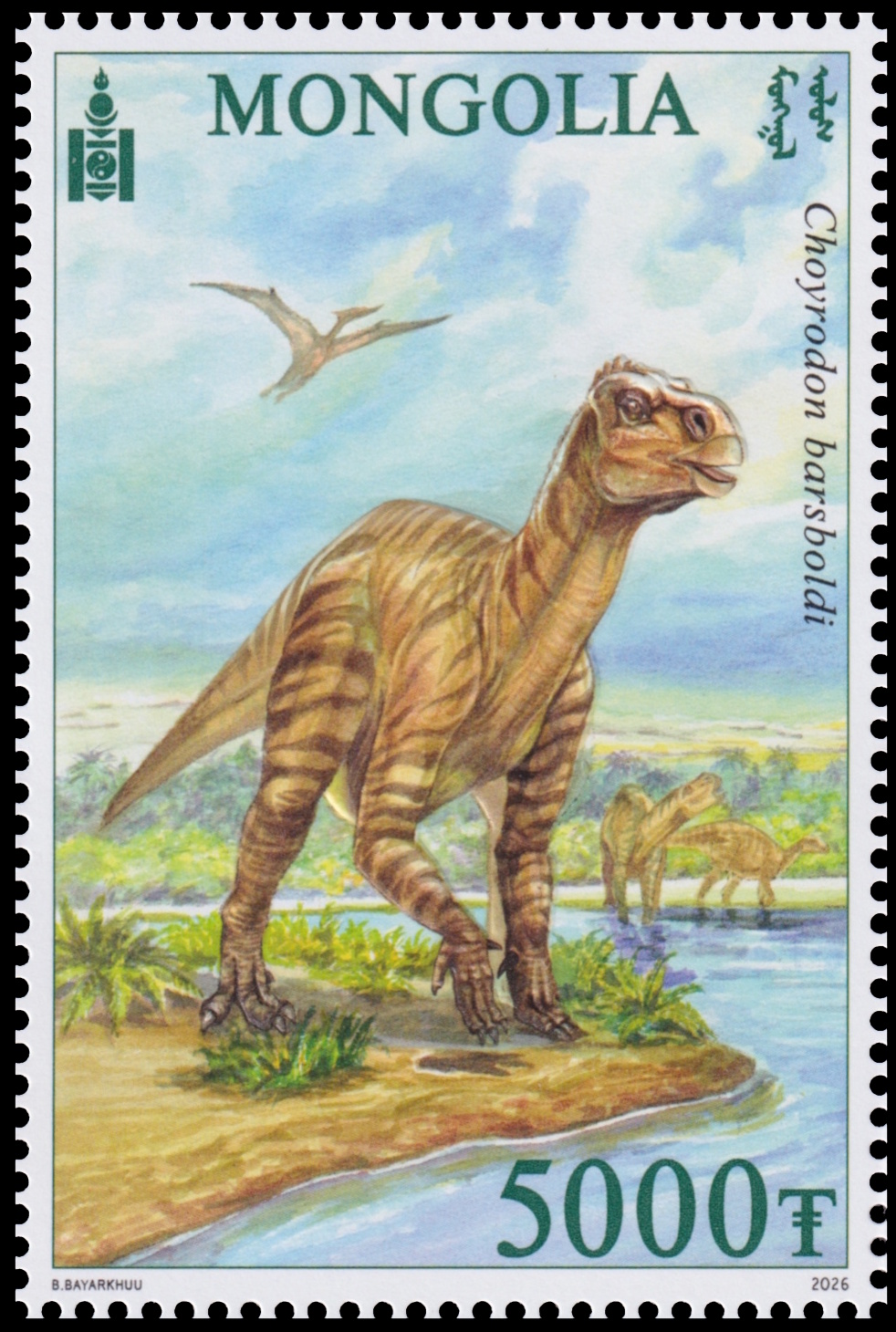
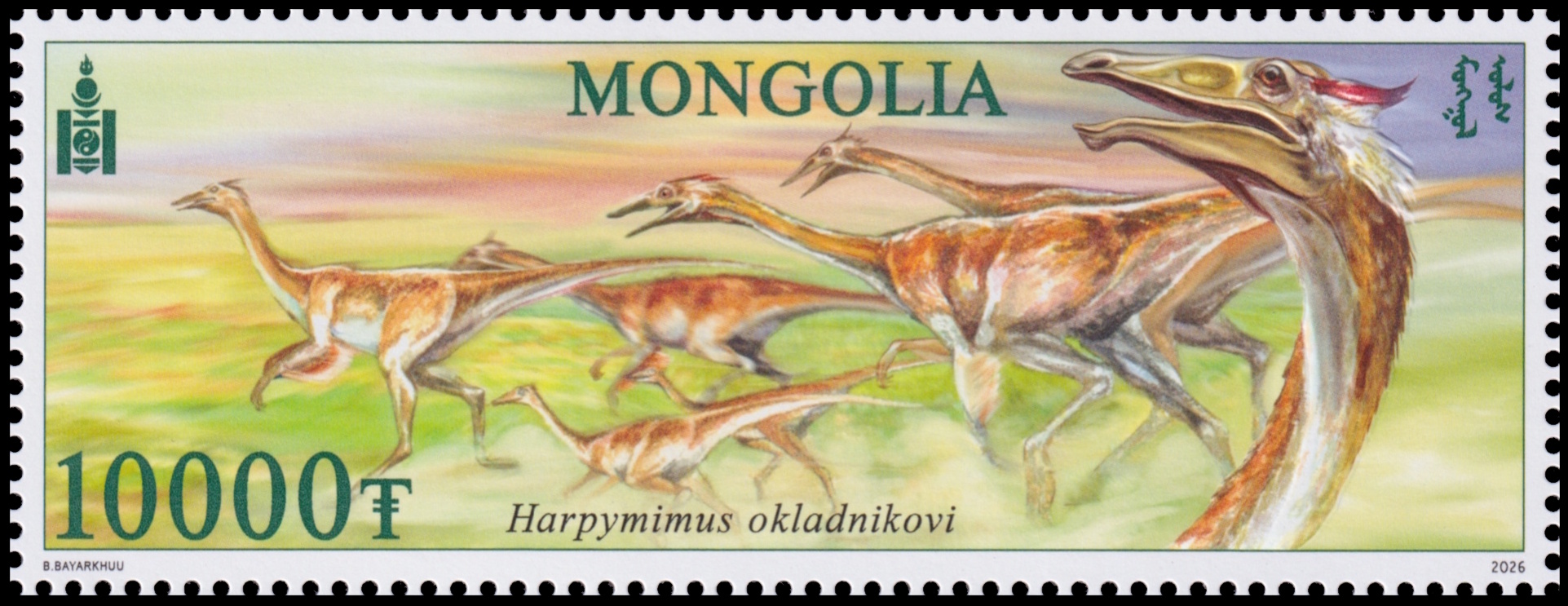
They range from a primitive ornithopod (Choyrodon) and one of the earliest ornithomimosaurs
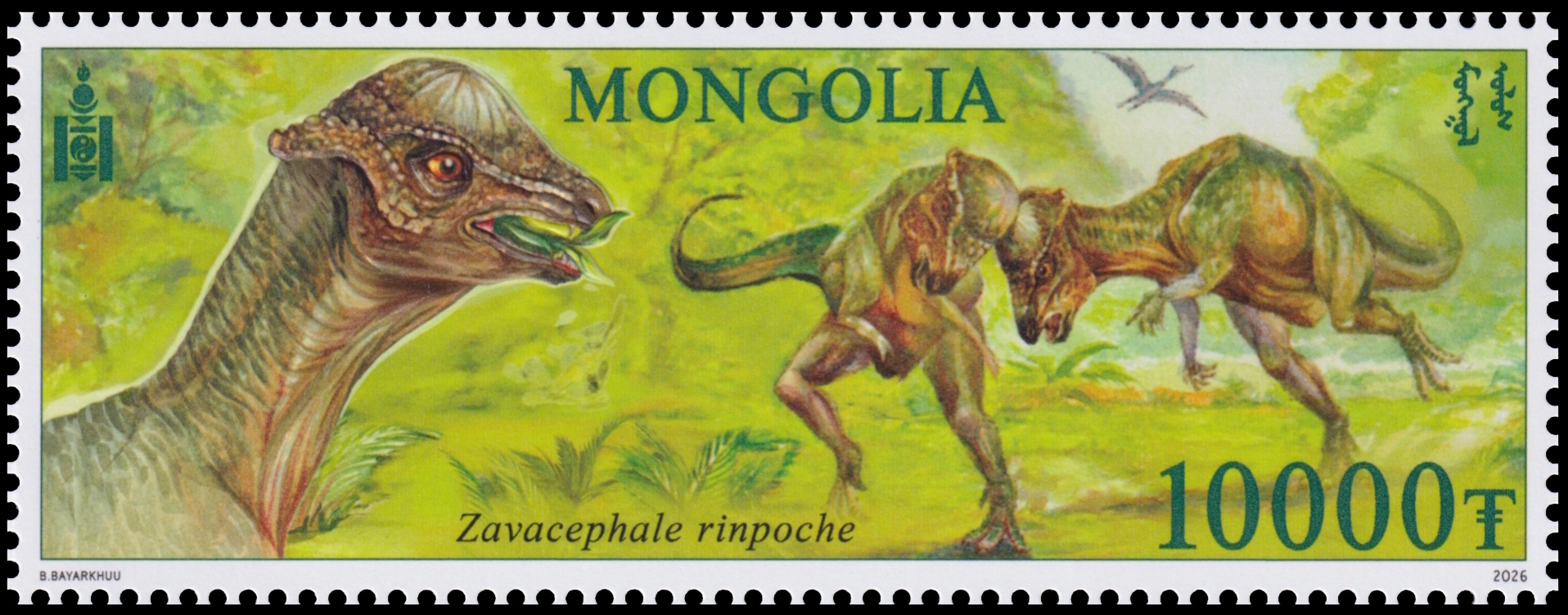
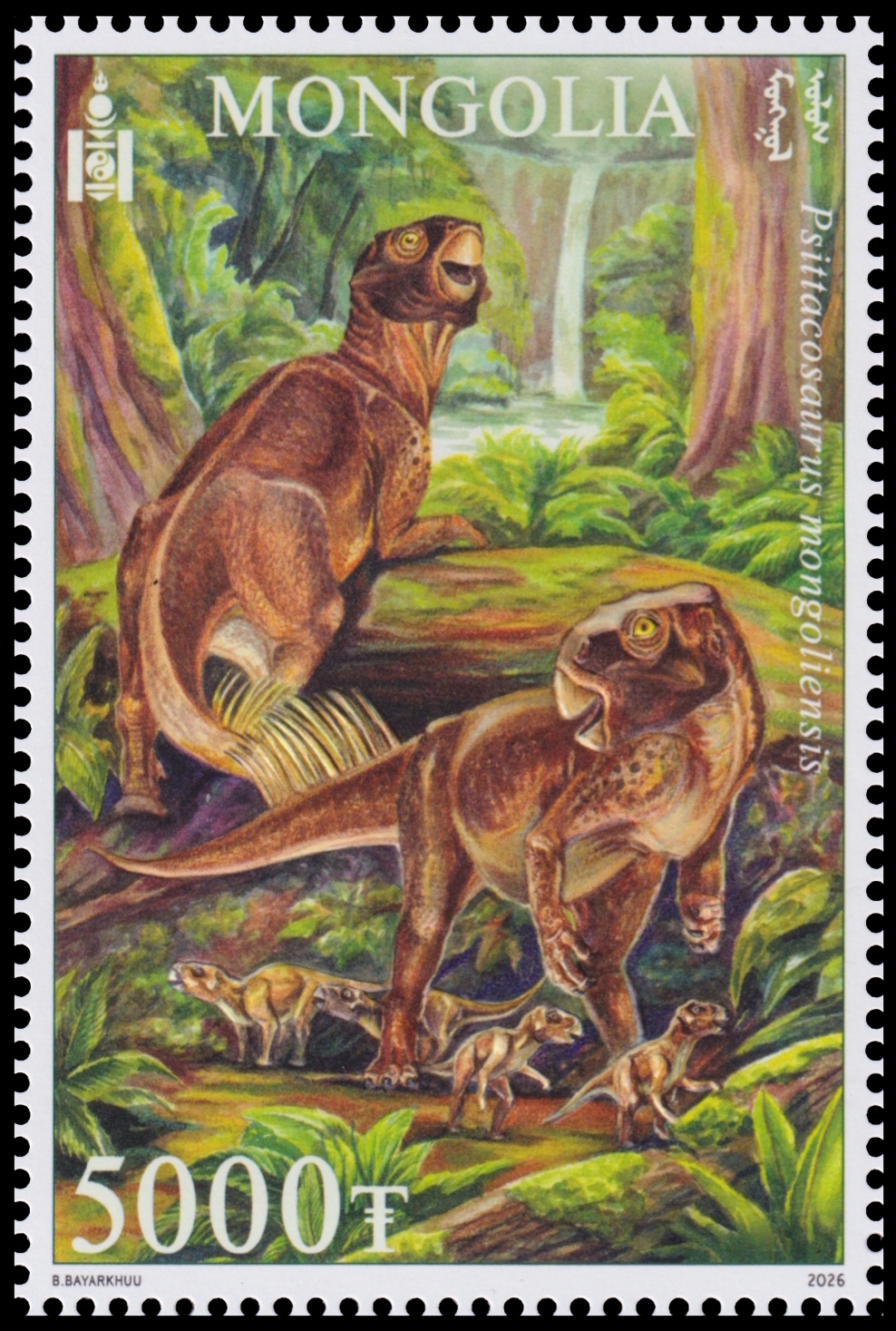
(Harpymimus) to a basal ceratopsian (Psittacosaurus) and an early pachycephalosaur
(Zavacephale).
Together, they illustrate the evolutionary adaptations that enabled dinosaurs to occupy a wide
variety of ecological niches in the ancient ecosystems of Mongolia.
The dinosaurs depicted on the stamps
Choyrodon barsboldi
Choyrodon barsboldi on stamp of Mongolia 2026,
MiNr.: ?, Scott: ?.
Choyrodon barsboldi was a medium-sized herbivorous ornithopod dinosaur that lived in what is
now Mongolia during the Early Cretaceous, approximately 113–94 million years ago (Albian–Cenomanian).
Described in 2018 from fossils discovered in the Khuren Dukh Formation of Dornogovi Province, it is regarded as a basal iguanodontian
closely related to Altirhinus. Choyrodon possessed a lightly built body, long hind limbs adapted for rapid movement, and a distinctive elongated snout.
Like other ornithopods, it fed on low-growing vegetation using its beak and specialized cheek teeth for cropping and grinding plants.
The genus name derives from the Mongolian word choir ("snout"), referring to its unusually elongated skull,
while the species name honors the distinguished Mongolian paleontologist Rinchen Barsbold for his
outstanding contributions to dinosaur research.
Harpymimus okladnikovi
Harpymimus okladnikovi on stamp of Mongolia 2026,
MiNr.: ?, Scott: ?.
Harpymimus okladnikovi was a medium-sized ornithomimosaur ("ostrich-mimic" dinosaur) that
lived in what is now Mongolia during the Early Cretaceous, approximately 125–100 million years ago.
Discovered in the Khuren Dukh Formation of Dornogovi Province and described in 1984, it represents one of the earliest
known members of the Ornithomimosauria.
Unlike its later relatives, Harpymimus retained numerous small teeth in its lower jaw,
indicating an intermediate stage in the evolution of the group before the development of the completely toothless beak
seen in more advanced ornithomimosaurs such as Gallimimus and Struthiomimus.
It had long, slender legs adapted for rapid running and is thought to have been an omnivore, feeding on small animals,
insects, fruits, and other plant material.
The genus name means "harpy mimic," referring to the mythical creature of Greek mythology, while the
species name honors the Soviet archaeologist and historian Alexey Pavlovich Okladnikov.
Zavacephale rinpoche
Zavacephale rinpoche on stamp of Mongolia 2026,
MiNr.: ?, Scott: ?.
Zavacephale rinpoche was a small herbivorous or omnivorous pachycephalosaur that lived in what is now Mongolia
during the late Early Cretaceous, approximately 100 million years ago.
Described in 2025 from fossils discovered in the Khuren Dukh Formation, it is one of the oldest known members
of the Pachycephalosauria.
Like other members of the group, Zavacephale was distinguished by its thickened skull roof,
although its cranial dome was less developed than that of later pachycephalosaurs, providing valuable insights into
the early evolution of these "dome-headed" dinosaurs.
It was a small, lightly built biped that probably fed on low-growing vegetation, fruits, and seeds, although an
omnivorous diet has also been suggested.
The genus name combines the Tibetan word zava, meaning "root" or "origin"
(referencing its basal evolutionary position), with the Greek kephale ("head").
The species name rinpoche is a Tibetan honorific meaning "precious one", alluding to the skull's
discovery resembling an exposed gemstone.
Psittacosaurus mongoliensis
Psittacosaurus mongoliensis on stamp of Mongolia 2026,
MiNr.: ?, Scott: ?.
Psittacosaurus mongoliensis was a small basal ceratopsian dinosaur that lived in what is now Mongolia during
the Early Cretaceous, approximately 125–100 million years ago.
One of the best-known early horned dinosaurs, it was characterized by its parrot-like beak, bipedal posture,
and a relatively short, robust body.
Unlike its later ceratopsian relatives such as Triceratops, Psittacosaurus lacked horns and a large neck frill,
representing an early stage in ceratopsian evolution.
It fed primarily on low-growing vegetation, using its sharp beak to crop plants and its strong jaws to process tough plant material.
Exceptional fossil discoveries from Mongolia and neighboring China have preserved complete skeletons, skin impressions,
and even long bristle-like structures on the tail, making Psittacosaurus one of the best-understood dinosaurs
in the fossil record.
The species Psittacosaurus mongoliensis was first described in 1923 from specimens collected during the famous Central Asiatic Expeditions
led by the American Museum of Natural History.
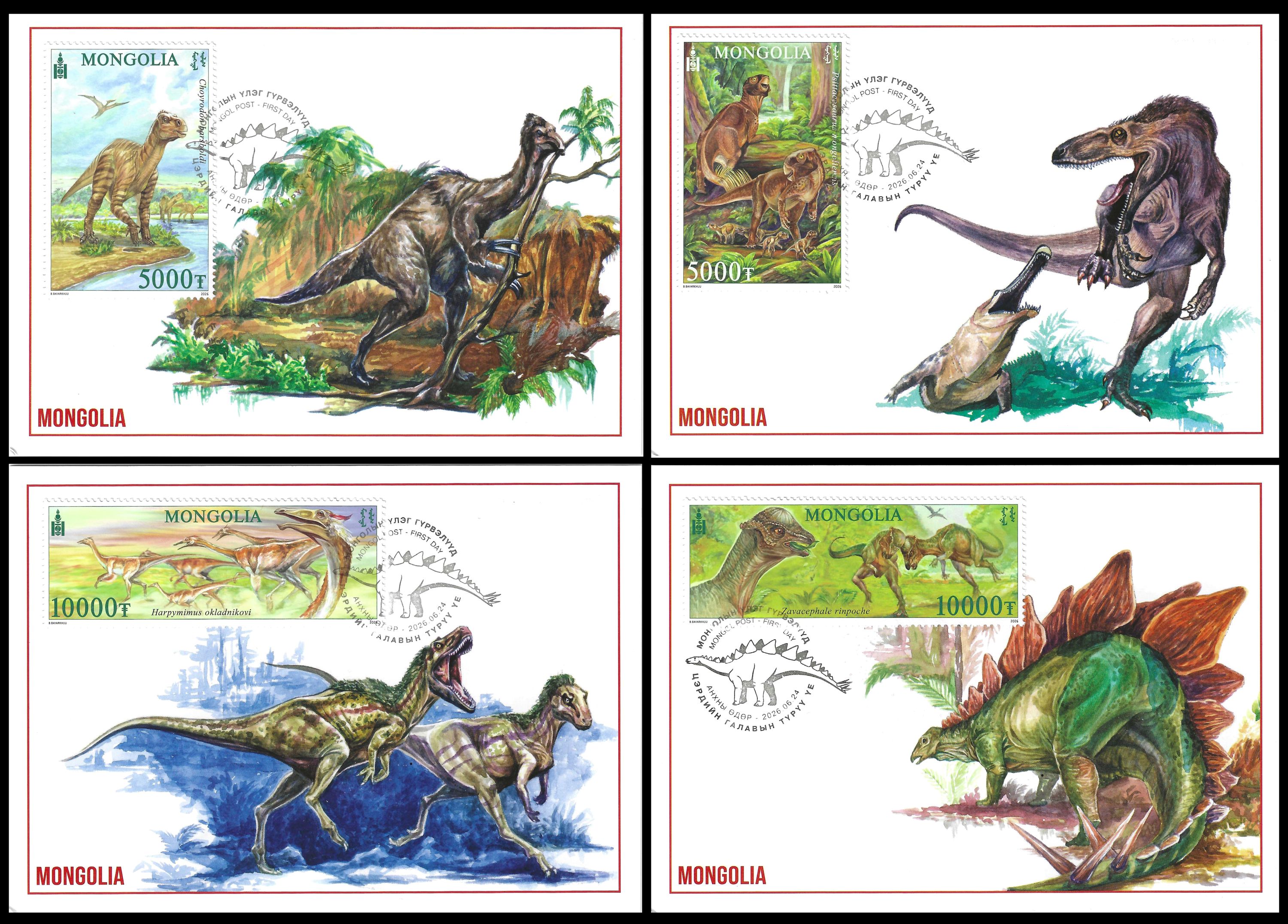
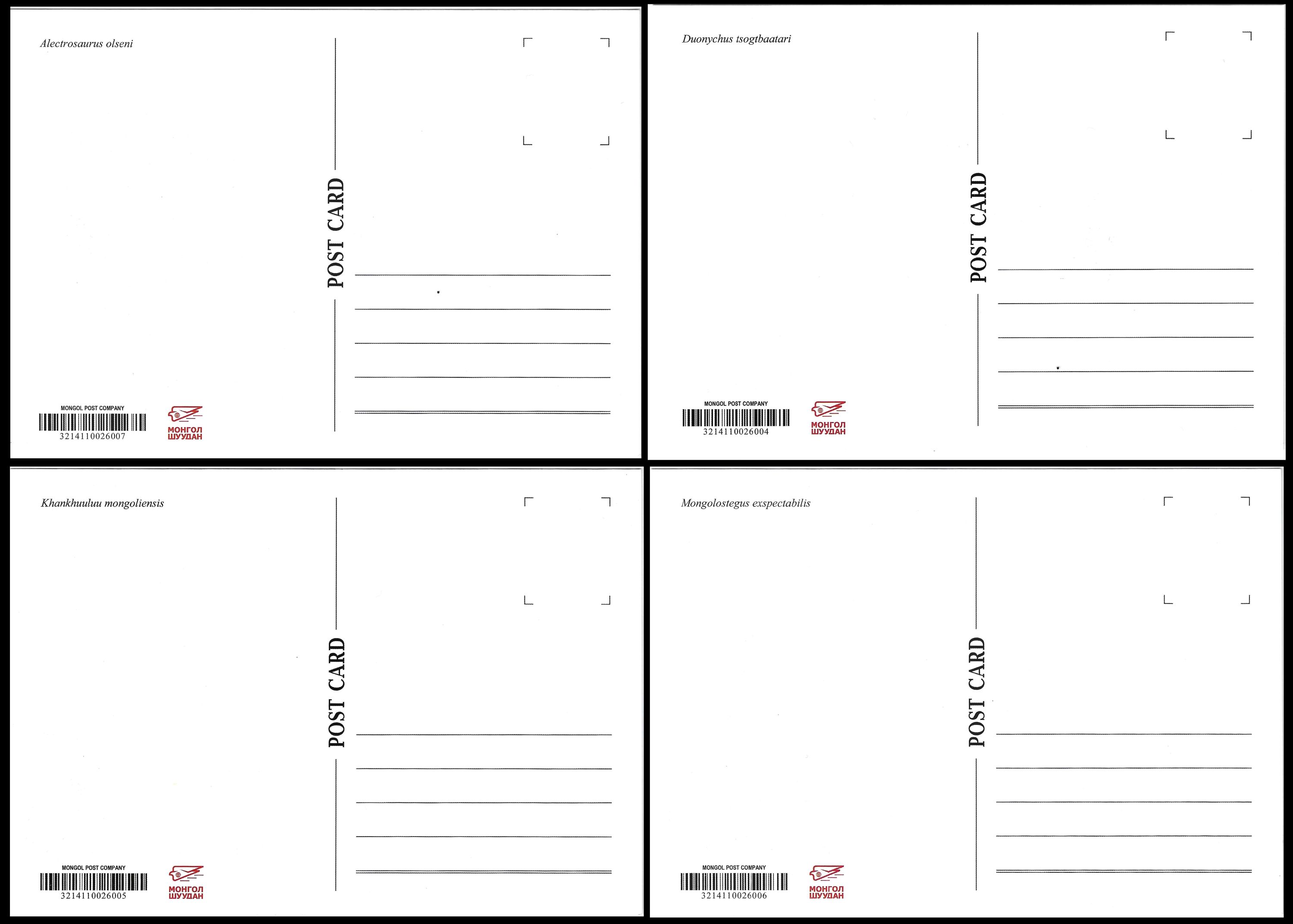
The reverse sides are here.
The artwork on both the Maxim Cards are different species than shown on the stamps.
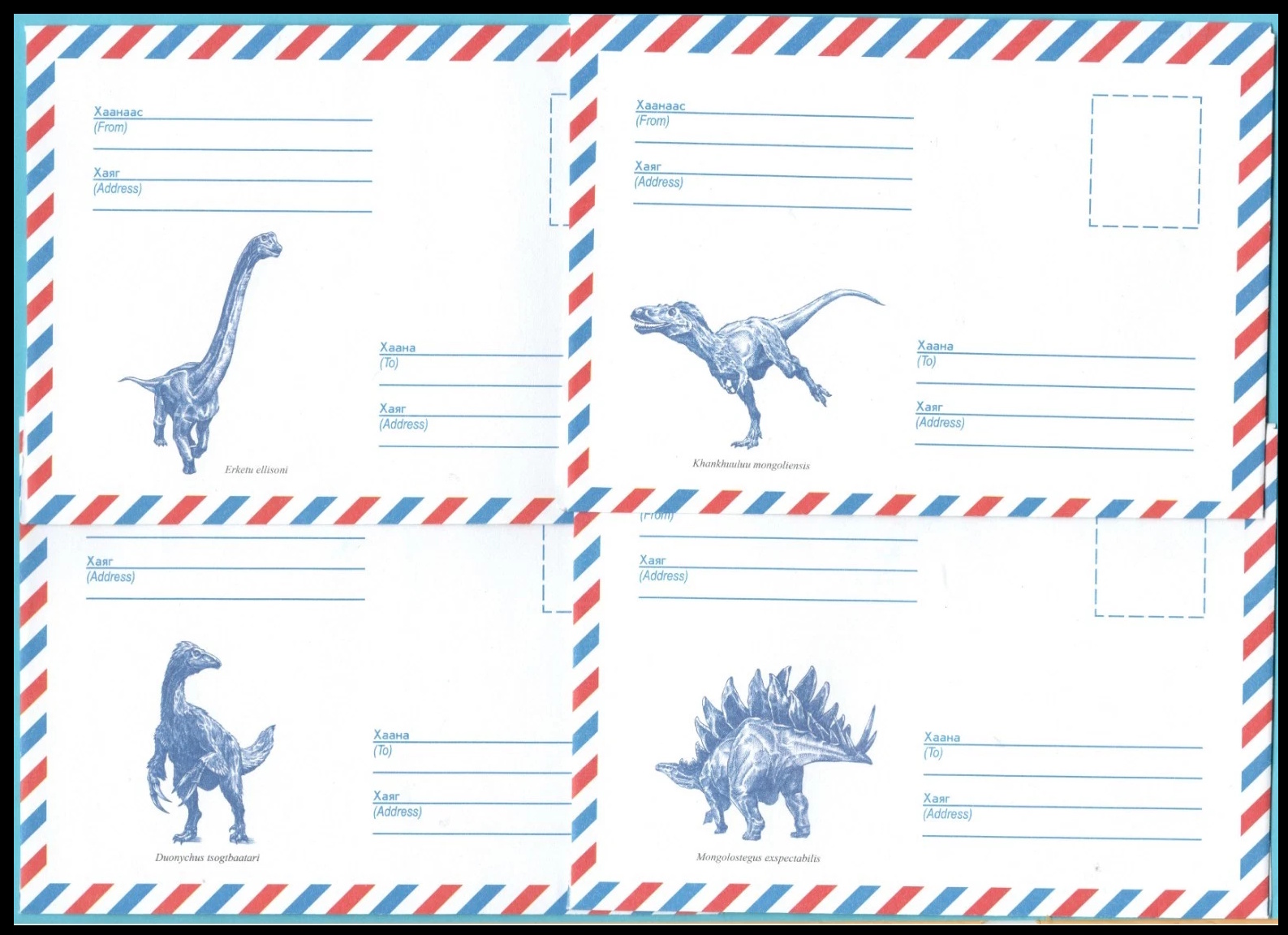
Commemorative Covers
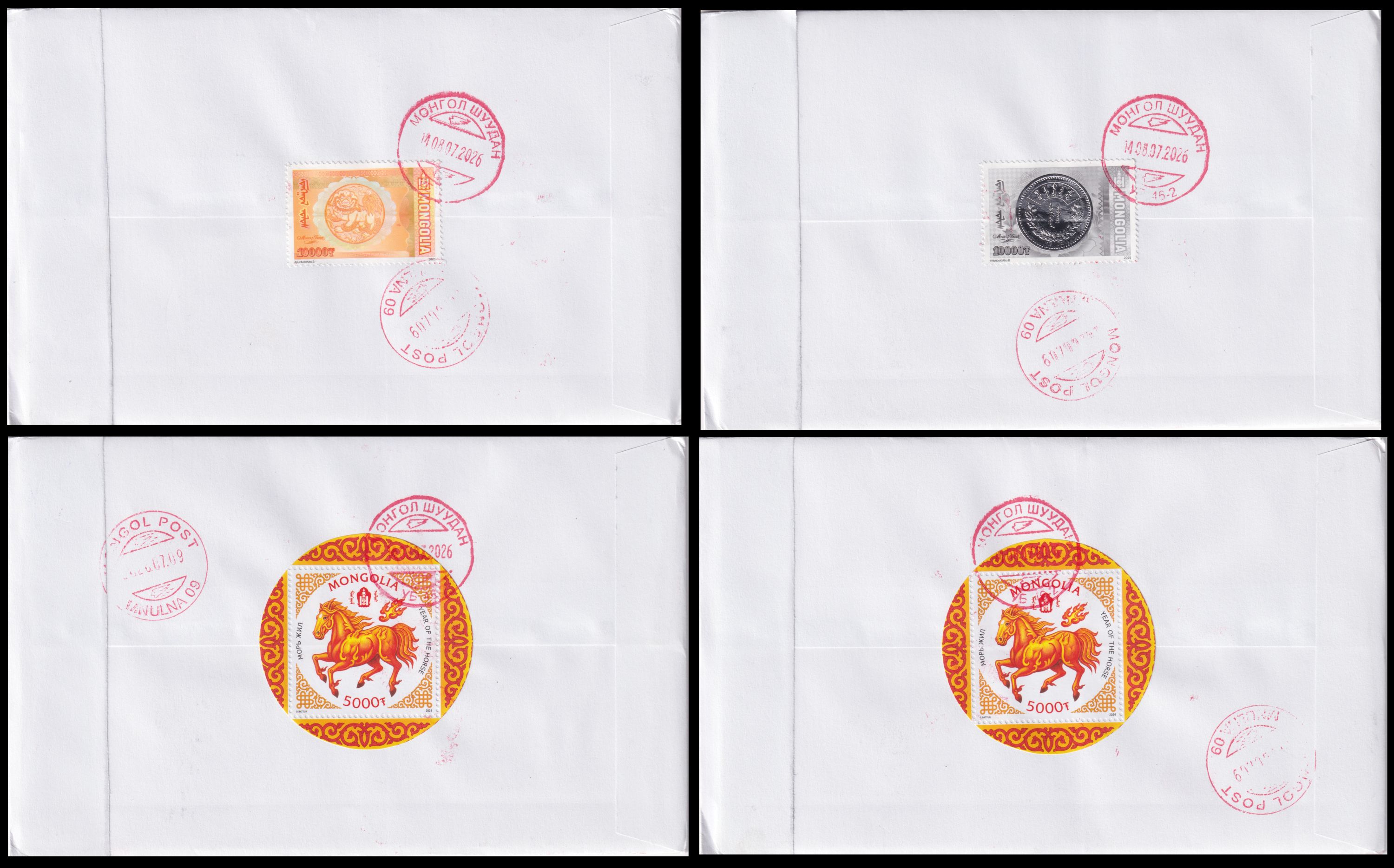
These covers appeared on the market at the same time as the stamp issue and may be related to it.
The artwork on both the Commemorative Covers are different species than shown on the stamps.
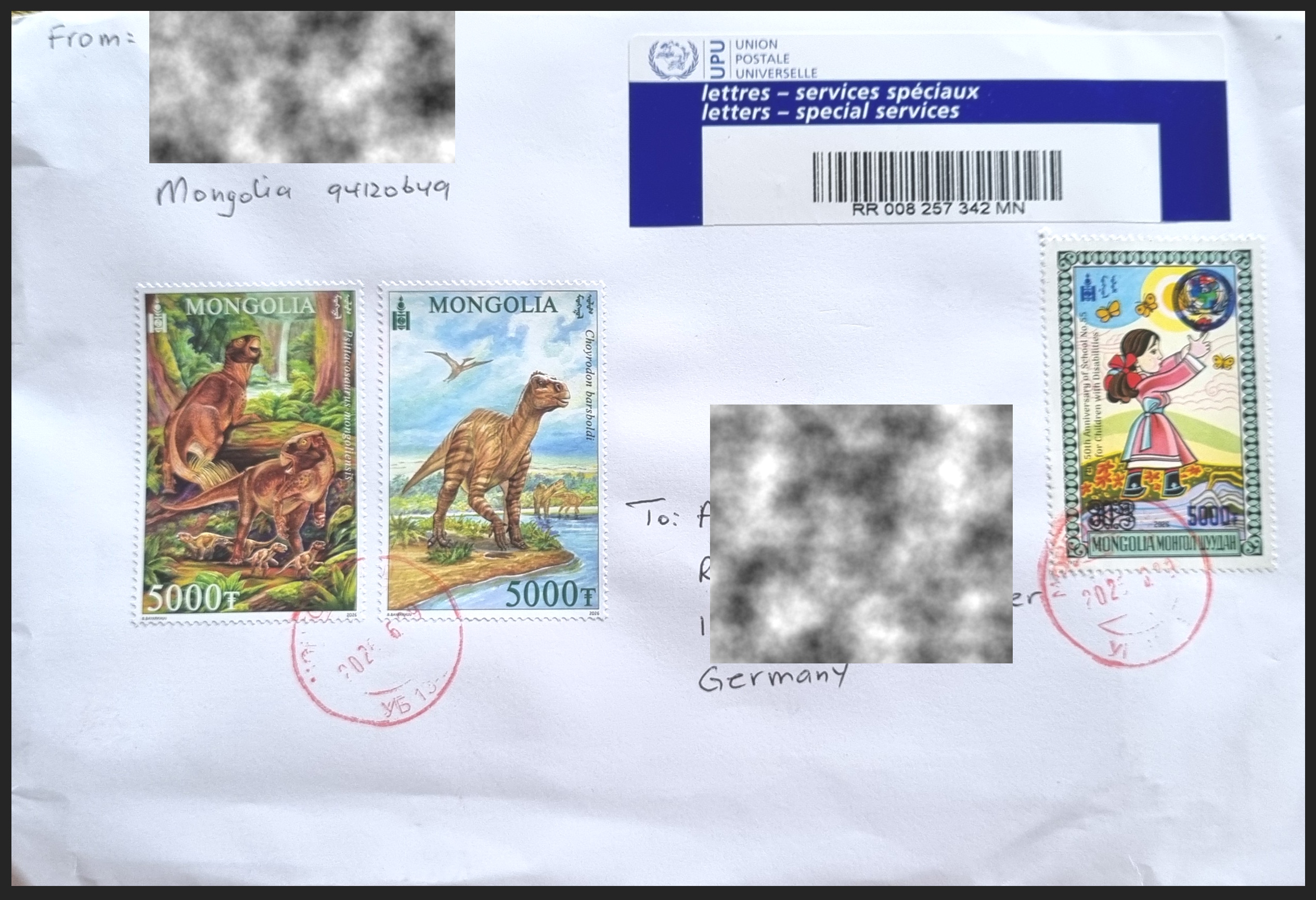
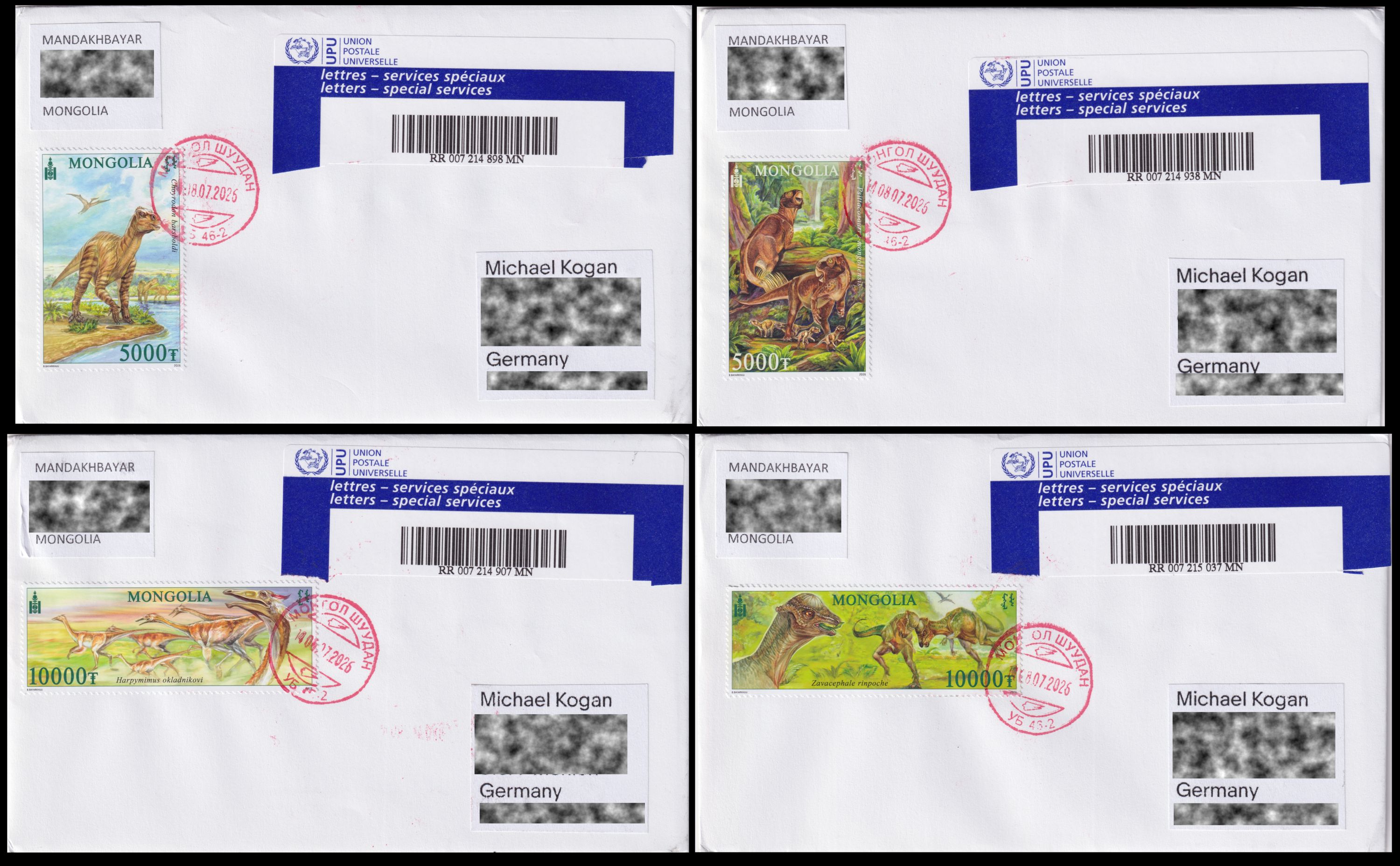
Many thanks to a fellow collector Andreas Franze from Germany for providing a scan of
a commercially used cover from his collection.
Many thanks to Dr. Peter Voice from Department of Geological and Environmental Sciences, Western Michigan University,
for providing scans of Maxi Cards from his collection, and for reviewing the draft page and his valuable comments.