Kiribati
Dinosaurs, prehistoric animals and Charles Darwin on stamps of Kiribati
Kiribati, officially the Republic of Kiribati is an island nation in the central Pacific Ocean.
The nation comprises 33 atolls and reef islands and one raised coral island, Banaba.
They have a total land area of 800 square kilometres and are dispersed over 3.5 million square kilometres
Their spread straddles the equator and the 180th meridian, although the International Date Line
is idented to ensure that both the Line Islands and the Kiribati islands are on the same day.
The permanent population is just over 100,000 (2011), more than half of whom live on Tarawa Atoll.
Kiribati was formerly the Gilbert Islands, part of the Gilbert and Ellice Islands which split into Kiribati and Tuvalu upon gaining independence from the United Kingdom in 1978 and 1979.
The capital and now most populated area, South Tarawa, consists of a number of islets, connected by a series of causeways. These comprise about half the area of Tarawa Atoll.
Kiribati is a member of the Commonwealth of Nations, the IMF and the World Bank, and became a full member of the United Nations in 1999. [R1]
The first stamps of Kiribati were a pair issued on 19 November 1979 to mark the independence of the country. [R2]
Notes:
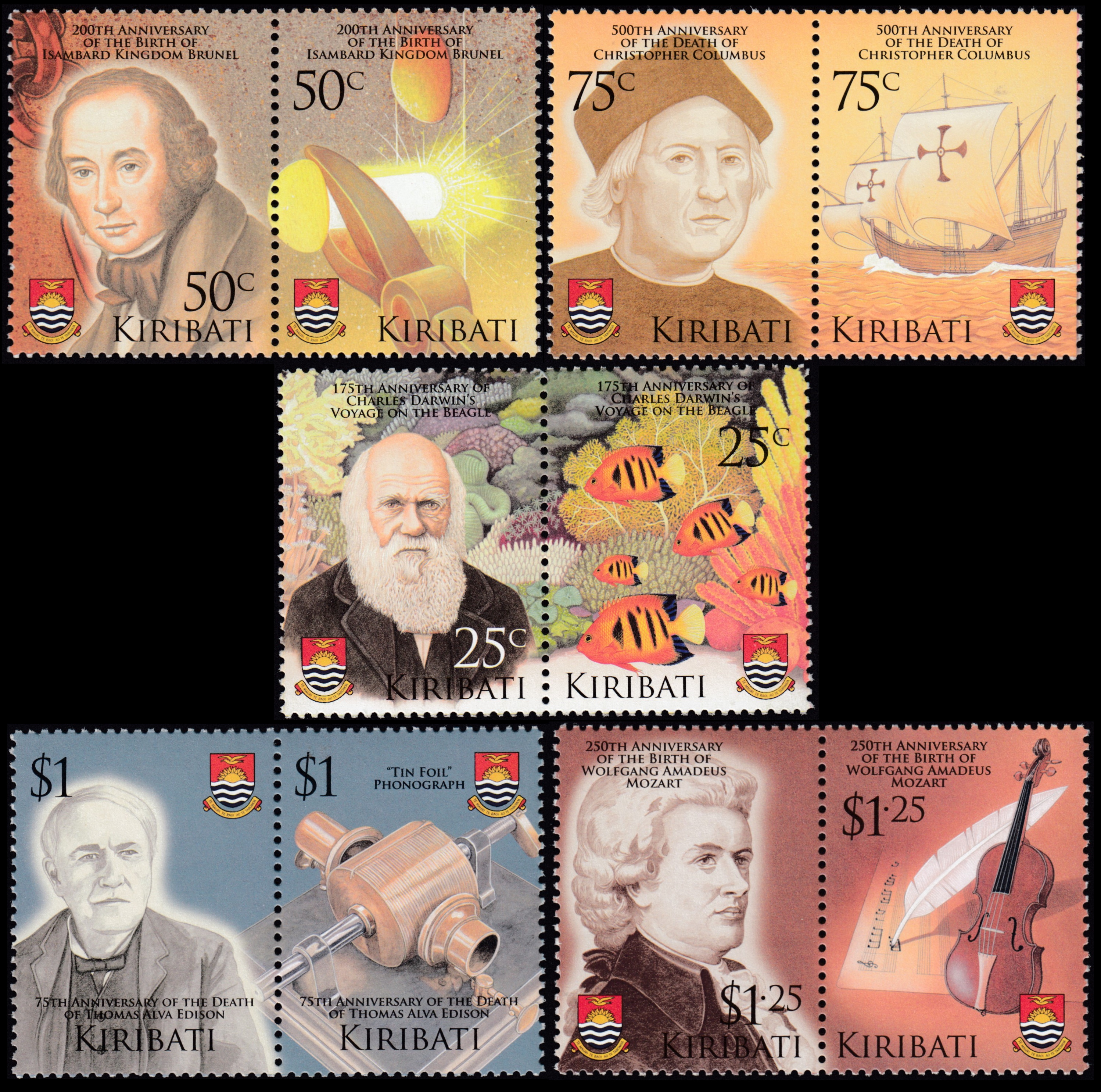
[1] There is one pair of stamps dedicated to Charles Darwin: one with his portrait and another one with tropical fishes with the following text on it "175th anniversary of Charles Darwin's voyage on the Beagle".
During his famous journey, Charles Darwin visited Manra Island or Sydney Island,
one of the Phoenix Islands in the Republic of Kiribati.
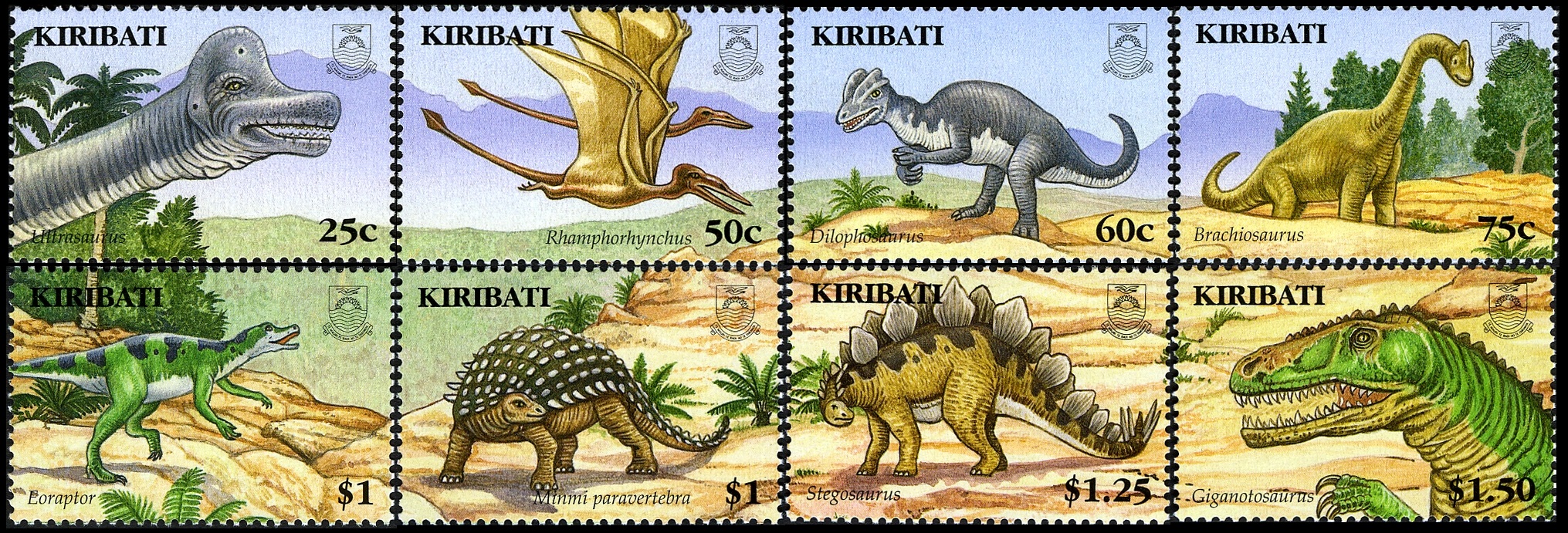
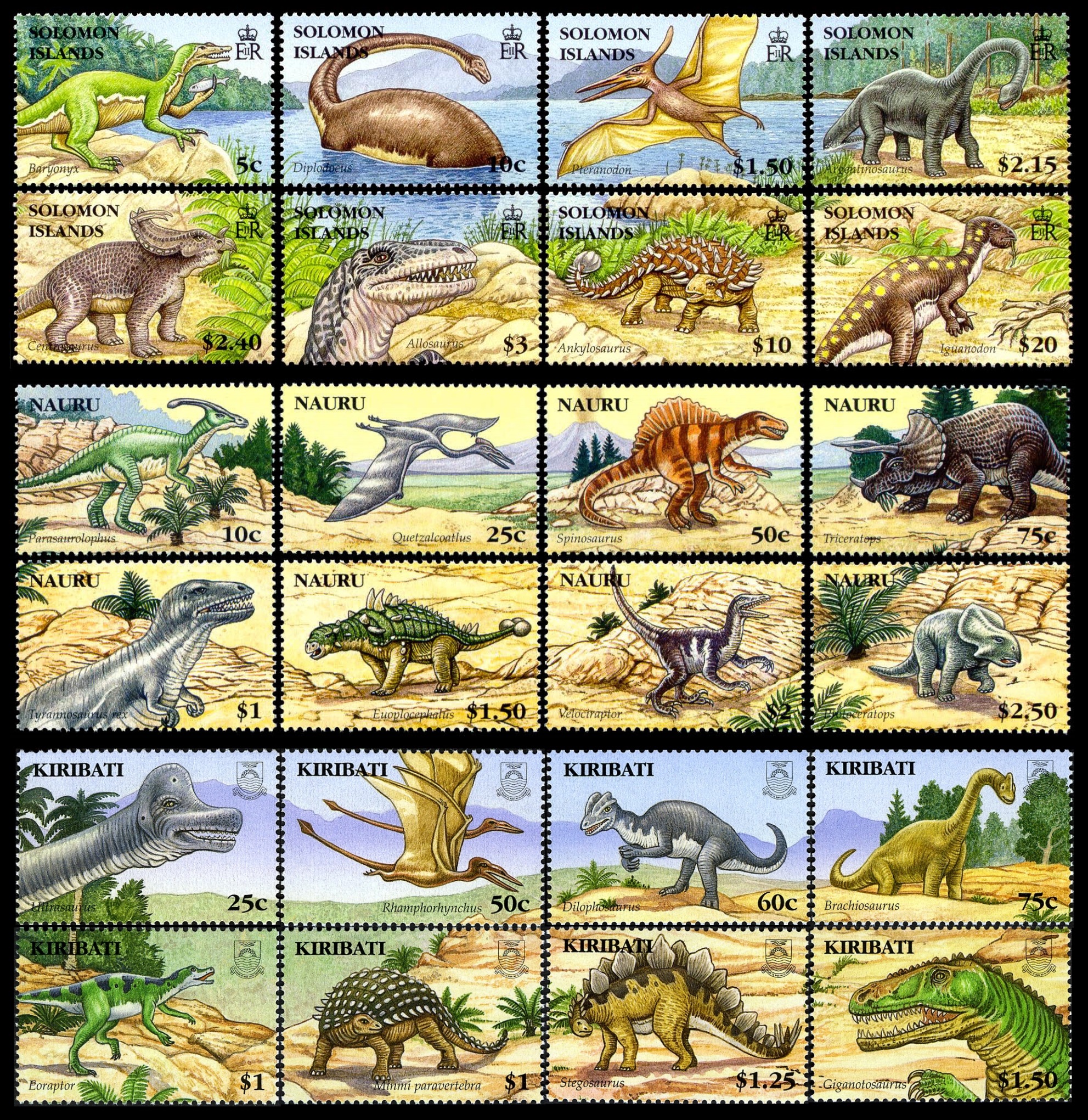
[2] Three island country: Solomon Islands, Nauru and Kiribati issued in 2006 stamps with prehistoric animals of very similar design. Most likely designed by the same artist or agency. These stamps are also little bit unusual - there are puzzle stamp. Each set build a picture if the stamps are placed in two rows in order of increasing face value.
Notes:
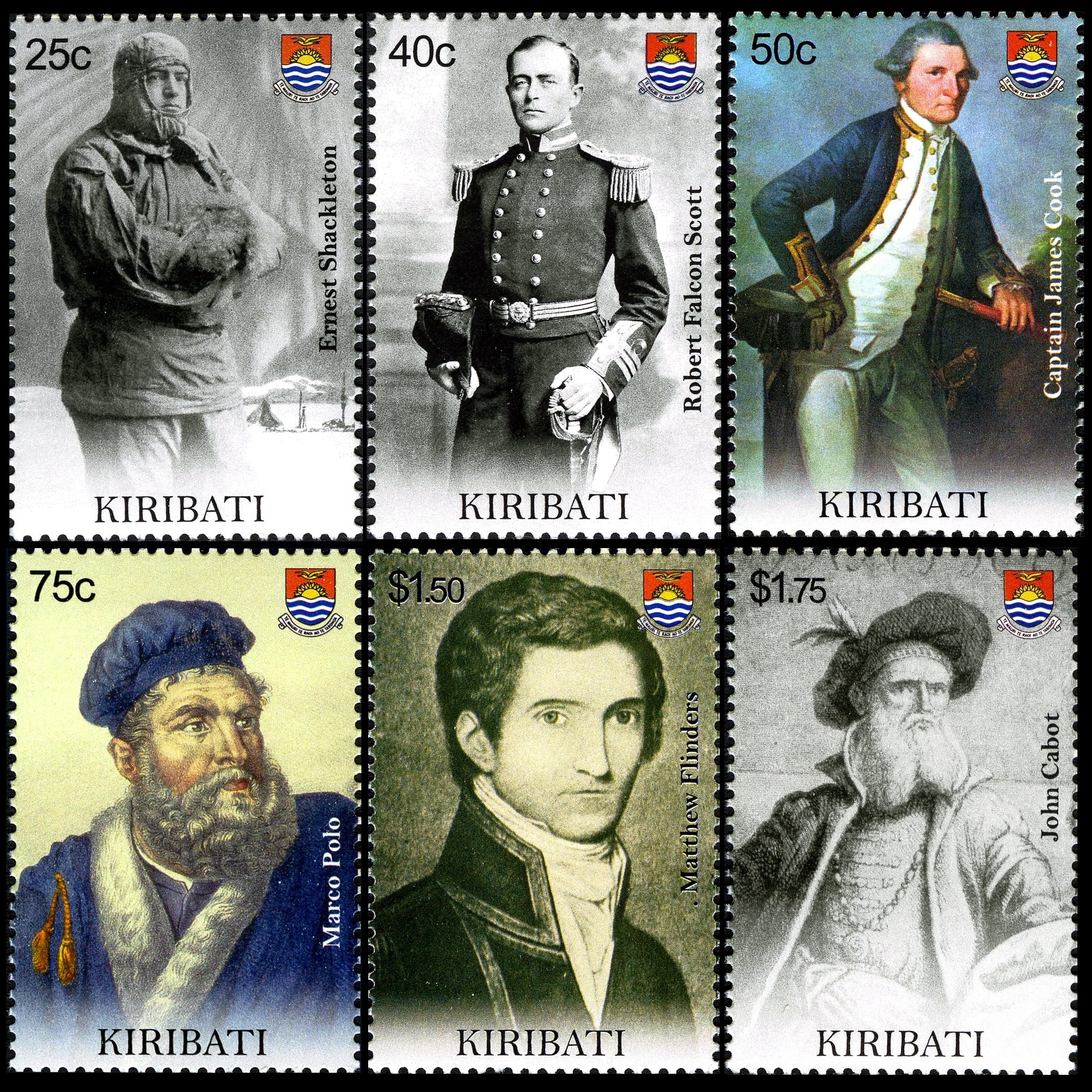
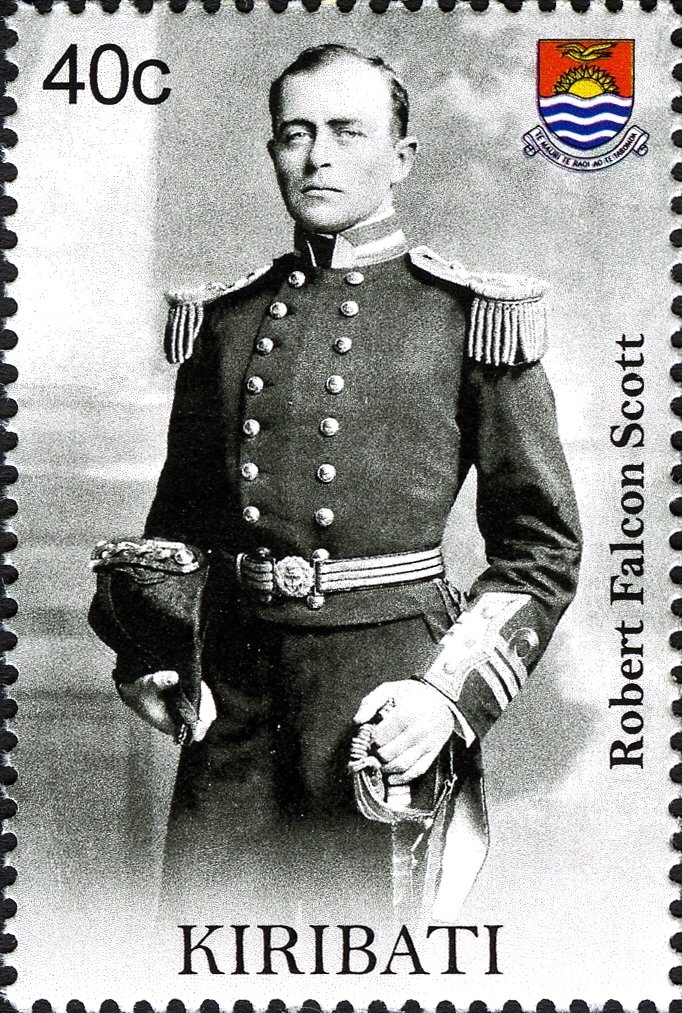
[A1] The stamp with the face value of 40c show Robert Falcon Scott.
Robert Falcon Scott CVO (6 June 1868 – 29 March 1912) was a Royal Navy officer and explorer
who led two expeditions to the Antarctic regions: the Discovery expedition of 1901–1904
and the ill-fated Terra Nova expedition of 1910–1912.
Scott and his companions died on the second expedition. When Scott and his party's bodies were discovered, 16kg of Glossopteris (an extinct beech-like tree from 250 million years ago) fossils from the Queen Maud Mountains were found next to their bodies, which they had dragged on hand sledges.
These fossils were promised to Marie Stopes (shown on UK stamp in 2008) to provide evidence for Eduard Suess's idea that Antarctica had once been part of an ancient super-continent named Gondwanaland (now Gondwana).
More details are here.
Legend is here
Many thanks to Dr. Peter Voice from Department of Geological and Environmental Sciences, Western Michigan University, for reviewing the draft page and his valuable comments.
Kiribati was formerly the Gilbert Islands, part of the Gilbert and Ellice Islands which split into Kiribati and Tuvalu upon gaining independence from the United Kingdom in 1978 and 1979.
The capital and now most populated area, South Tarawa, consists of a number of islets, connected by a series of causeways. These comprise about half the area of Tarawa Atoll.
Kiribati is a member of the Commonwealth of Nations, the IMF and the World Bank, and became a full member of the United Nations in 1999. [R1]
The first stamps of Kiribati were a pair issued on 19 November 1979 to mark the independence of the country. [R2]
Official stamps of Kiribati related to Paleontology: Dinosaurs and other prehistoric animals, Charles Darwin
| 27.05.2006 "Exploration and Innovation" [1] | 15.09.2006 "Dinosaurs" [2] | |
 |
 |
|
Notes:
[1] There is one pair of stamps dedicated to Charles Darwin: one with his portrait and another one with tropical fishes with the following text on it "175th anniversary of Charles Darwin's voyage on the Beagle".

|
|
| Charles Darwin on stamp of Kiribati 2006 MiNr.: 997, Scott: | Joint issue of Solomon Islands, Kiribati and Nauru |
[2] Three island country: Solomon Islands, Nauru and Kiribati issued in 2006 stamps with prehistoric animals of very similar design. Most likely designed by the same artist or agency. These stamps are also little bit unusual - there are puzzle stamp. Each set build a picture if the stamps are placed in two rows in order of increasing face value.
Some other stamps of Kiribati to consider: contributors to Paleontology
| 09.03.2009 "Sea Explores" [A1] | ||
 |
||
Notes:
[A1] The stamp with the face value of 40c show Robert Falcon Scott.
|
| Robert Falcon Scott on stamp of Kiribati 2009 MiNr.: 1084, Scott: |
Scott and his companions died on the second expedition. When Scott and his party's bodies were discovered, 16kg of Glossopteris (an extinct beech-like tree from 250 million years ago) fossils from the Queen Maud Mountains were found next to their bodies, which they had dragged on hand sledges.
These fossils were promised to Marie Stopes (shown on UK stamp in 2008) to provide evidence for Eduard Suess's idea that Antarctica had once been part of an ancient super-continent named Gondwanaland (now Gondwana).

More details are here.
Commemorative postmarks of Kiribati related to Paleontology: dinosaurs
Legend is here
| 15.09.2006 "Dinosaurs" [FDC] | ||
 |
||
References
- [R1] Kiribati:
Wikipedia,
WikiTravel,
FlagCounter.
- [R2] Postal History and Philately of Kiribati:
Wikipedia,
Links to official website of the Post Authority, stamp catalog and a list of new stamps of Kiribati are here
Acknowledgements
Many thanks to Dr. Peter Voice from Department of Geological and Environmental Sciences, Western Michigan University, for reviewing the draft page and his valuable comments.