Egypt 2008 "Environment Day - Wadi El-Hitan the oldest world Natural Heritage Site in Egypt"
| Issue Date | 10.02.2008 |
| ID | Michel: 2349-2350; Scott: 2014a-2014b; Stanley Gibbons: 2484-2485; Yvert et Tellier: 1984-1985 ; Category: pF |
| Design | |
| Stamps in set | 2 + 1 label in between |
| Value | 30pt - Basilosaurus bones/ Archaeoceti fossils 30pt - sculpture representing a fossil whale. |
| Emission/Type | commemorative |
| Places of issue | Cairo |
| Size (width x height) | 50x30 mm |
| Layout | 50 stamps per sheet |
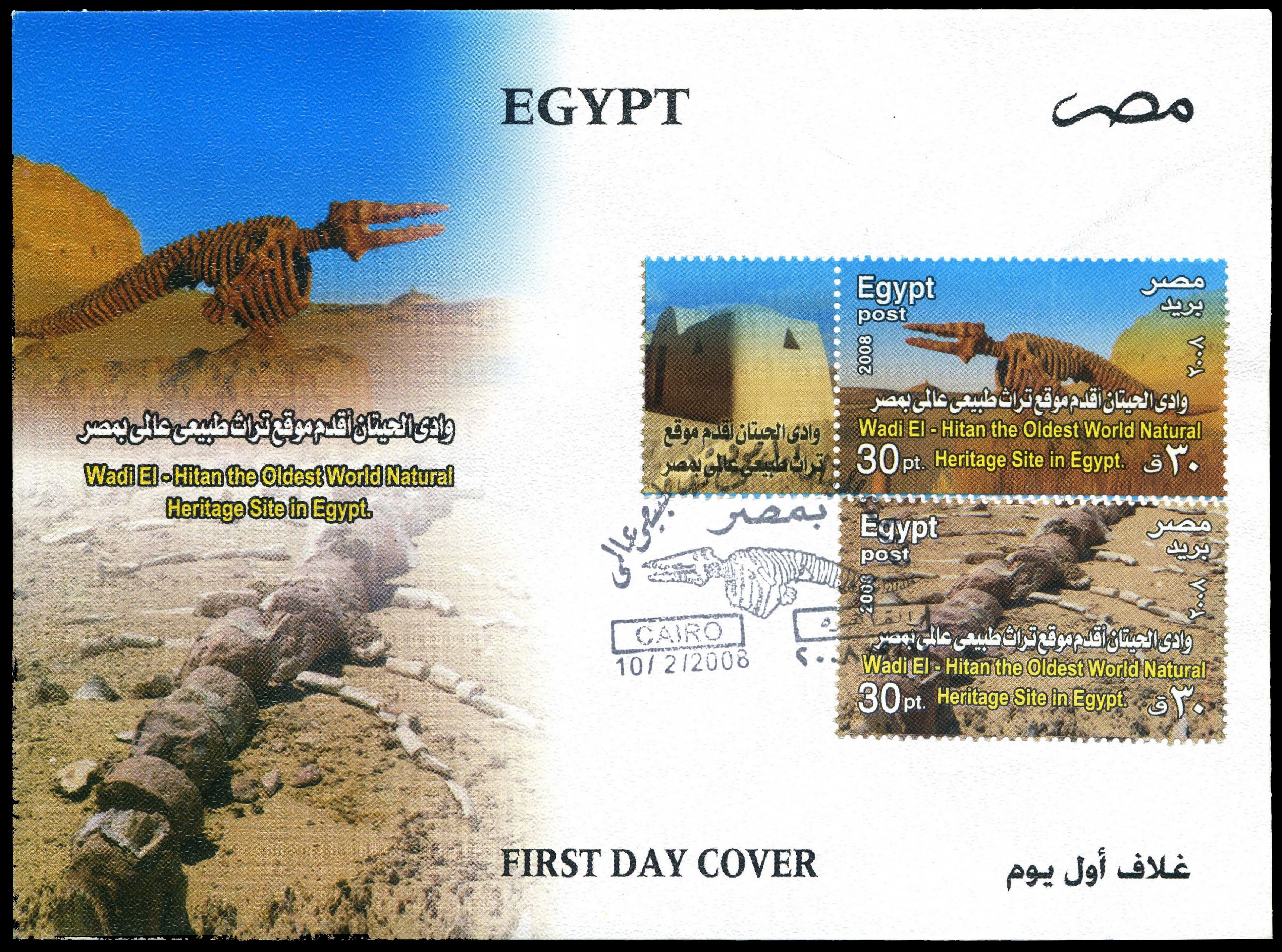
| Products | FDC x 1 |
| Paper | |
| Perforation | 12,75 x 13,25 |
| Print Technique | Offset, multicolor |
| Printed by | |
| Quantity | |
| Issuing Authority | National Postal Organization of Egypt |
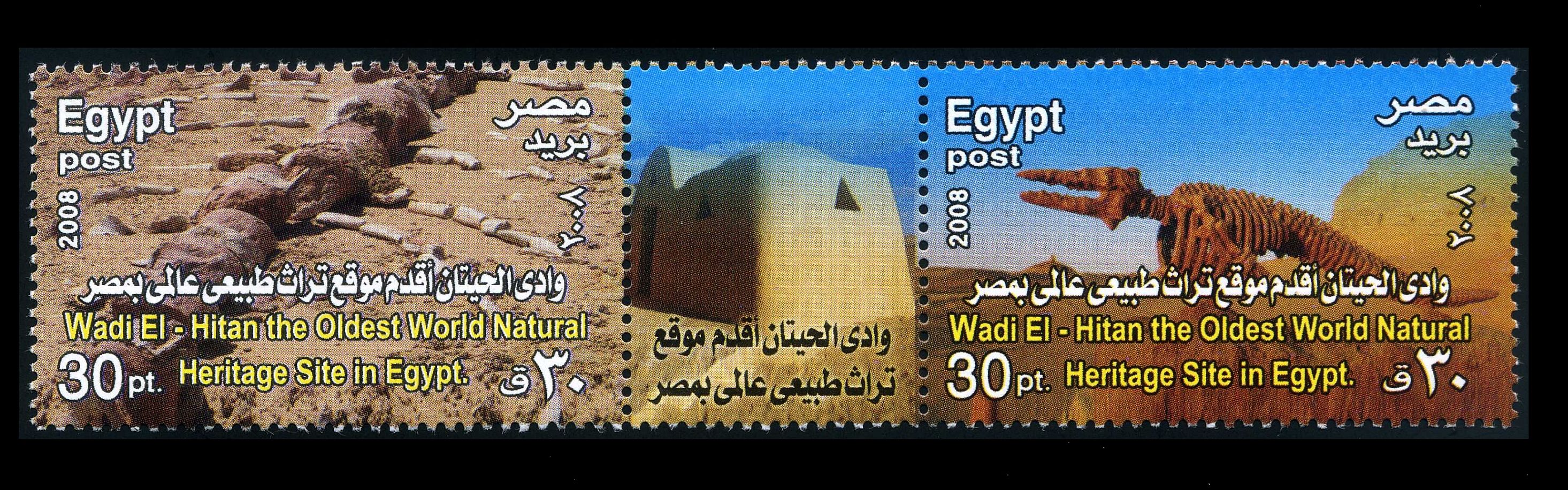
On February 10th 2008, Egyptian Post issued the set of two se-tenant stamps with a decorative label in the middle "Environment Day - Wadi El-Hitan the oldest world Natural Heritage Site in Egypt".
Wadi Al-Hitan, is a paleontological site in the Al Fayyum Governorate of Egypt, some 150 km southwest of Cairo. It was designated a UNESCO World Heritage Site in July 2005 for its hundreds of fossils of some of the earliest forms of whale, the archaeoceti (a now extinct sub-order of whales).
No other place in the world yields the number, concentration and quality of such fossils, as is their accessibility and setting in an attractive and protected landscape.
This is why it was added by the UNESCO to the list of protected World Heritage sites.
The fossils found at the site may not be the oldest but their great concentration in the area and the degree of their preservation is to the extent that even some stomach contents are intact.
The presence of fossils of other early animals such as sharks, crocodiles, sawfish, turtles and rays found at Wadi El-Hitan makes it possible to reconstruct the surrounding environmental and ecological conditions of the time, adding to its justification to be cited as a Heritage site.
The first fossil skeletons of whales were discovered in the winter of 1902-3. For the next 80 years they attracted relatively little interest, largely due to the difficulty of reaching the area.
In the 1980s interest in the site resumed as four wheel drive vehicles became more readily available.
Continuing interest coincided with the site being visited by fossil collectors, and many bones were removed, prompting calls for the site to be conserved.
The remains display the typical streamlined body form of modern whales yet retaining some of the primitive aspects of skull and tooth structure.
The largest skeleton found reached up to 21 m in length, with well-developed five-fingered flippers on the forelimbs and the unexpected presence of hind legs, feet, and toes, not known previously in any archaeoceti.
Their form was serpentine, and they were carnivorous. A few of these skeletal remains are exposed but most are shallowly buried in sediments, slowly uncovered by erosion.
Wadi El-Hitan provides evidence of millions of years of coastal marine life.
Products and associated philatelic items
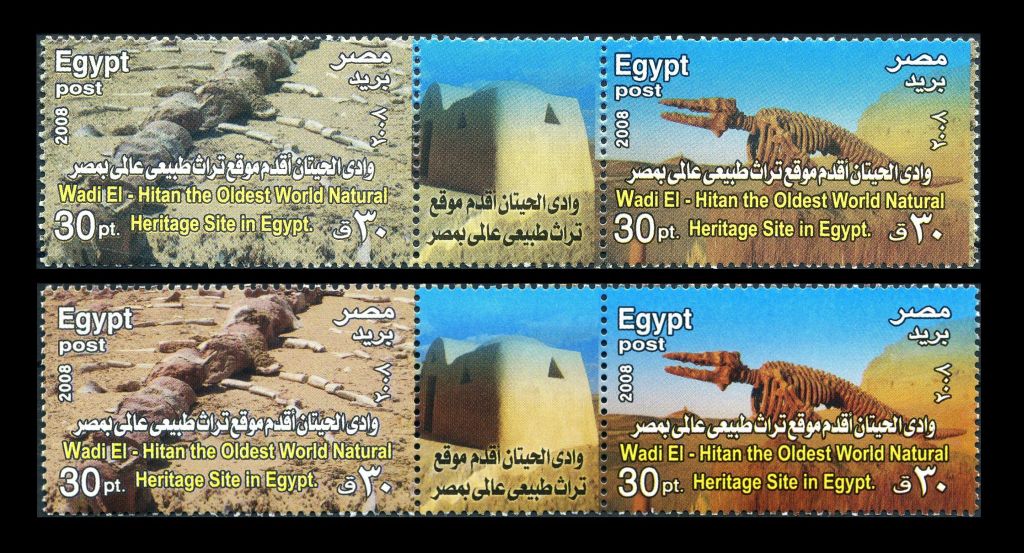
| FDC | Stamps Sheet | Color variations |
 |
 |
 |
References
- Technical details and short description of the stamps:
Colnect, - Wadi al Hitan:
Wikipedia, UNESCO, - Basilosaurus:
Wikipedia, Encyclopedia Britannica, National Geographic, Encyclopedia Britannica,
Acknowledgements
Many thanks to Dr. Peter Voice, PhD Department of Geological and Environmental Sciences, Western Michigan University, USA, for review of a draft of this article and his very valuable comments.